
Confidentiality in Executive Coaching: What Is Protected and What Is Not
Executive coaching confidentiality refers to the terms that determine which parts of an executive coaching engagement stay between the leader and the coach and which parts reach the sponsoring employer.
The coaching agreement sets those terms, with professional ethics codes as reference points.
Clinical privilege is a separate protection that Illinois law gives to information shared with licensed counselors, and it rests on statute rather than contract.
Key Takeaways
- The ICF Code of Ethics, effective April 1, 2025, binds ICF Professionals, defined as people who present themselves as ICF members or ICF credential holders.
- ICF Standard 2.3 asks coaches to agree in advance on disclosure in four situations: unlawful activity, a legal requirement, a court order or subpoena, and danger to the client or others.
- 225 ILCS 107/75 makes information that Illinois licensed counselors obtain in a professional capacity privileged, with release routes set out in subsections (a), (b), and (d).
- NBCC Code of Ethics Directive 32 (2023) requires counselors to explain the limits of confidentiality and obtain written informed consent.
Leaders can raise the issues of sponsor reporting, assessment sharing, and record handling during a no-cost consultation with Fettner Executive & Professional Career Coaching in Northbrook, Illinois.
Is Executive Coaching Confidential?
Executive coaching is confidential to the extent the coaching agreement allows it, along with any ethics code the coach follows. Coaching carries no state license in Illinois.
The International Coaching Federation (ICF) is a professional association, and its Code of Ethics binds ICF Professionals: people who present themselves as ICF members or ICF credential holders.
For coaches outside that group, the code is a published reference point rather than a binding rule. The code’s glossary treats coaching information as protected unless one of three conditions applies:
- A legal basis. A law or legal requirement calls for the information to be released.
- A threat of harm. Someone faces a risk of being hurt.
- Written consent. The client agrees in writing to the release.
Fettner Executive & Professional Career Coaching, an executive and career coaching practice in Northbrook, Illinois, assigns every engagement to Marilyn Fettner personally rather than to an associate coach.
How Does Coaching Confidentiality Differ From Clinical Privilege?
Coaching confidentiality is a contractual promise, while clinical privilege is a statutory protection. Section 75 of the Illinois Counselor Licensing Act makes information that licensed professional counselors and clinical professional counselors obtain in a professional capacity privileged, then sets out several routes for release.
| Point of Comparison | Coaching Confidentiality | Clinical Privilege Under 225 ILCS 107/75 |
| Source of the duty | The coaching agreement, plus the ICF Code for ICF Professionals | Illinois statute |
| Who must keep information private | The coach and anyone the agreement names | Licensed counselors, people with record access, and people who help deliver counseling (subsection c) |
| Licensing authority | None; coaching has no state license | Illinois Department of Financial and Professional Regulation |
| Release by consent | Terms in the agreement; the ICF glossary names the client’s written consent | Written consent of the person who gave the information or, after death or disability, a personal representative, a person authorized to sue, or certain insurance beneficiaries (subsection a) |
| Sharing with colleagues | Terms in the agreement | Formal reports or consultations with supervisors or colleagues who share professional responsibility, who must then treat the information as privileged (subsection a) |
| Risk of harm | Danger to the client or others, as agreed under ICF Standard 2.3 | A communication revealing an intended crime or harmful act, where disclosure is needed to protect against a clear, imminent risk of serious mental or physical harm or a serious threat to public safety (subsection a) |
| Court proceedings | Disclosure under a court order or subpoena, agreed in advance under ICF Standard 2.3 | Compelled testimony when a minor is the victim or subject of a crime, after the judge’s private review (subsection b); voluntary testimony in adoption, child abuse, child neglect, and other child-related matters (subsection d) |
| Waiver | Terms in the agreement | Waived when the person brings public charges against the counselor (subsection a) |
| Related law | Laws and agreements that apply to records (ICF Standard 2.4) | The Mental Health and Developmental Disabilities Confidentiality Act controls in a conflict (subsection e); the section applies in any work setting (subsection f) |
The Illinois Department of Financial and Professional Regulation licenses both professional counselors and clinical professional counselors under 225 ILCS 107. Marilyn Fettner holds IDFPR license 180.008430 as a Licensed Clinical Professional Counselor.
A licensed clinician coaching executives still provides coaching, not clinical care, and the practice refers leaders who need clinical support to other providers.
What Does a Sponsoring Employer Actually See?
A sponsoring employer sees what the coaching agreement assigns to it, plus anything released under a legal requirement or another agreed exception.
The ICF defines a sponsor as the person or organization that pays for, arranges, or defines coaching services. A coaching agreement can divide visibility along these lines:
| Information Category | Visible to the Leader | Visible to the Sponsoring Employer | Protected |
| Session content | Yes; the leader takes part in every session | Only as the agreement allows | Protected under the ICF glossary standard unless written consent, a legal requirement, or a threat of harm applies |
| Stated goals | Yes | When the agreement brings the sponsor into goal setting | Goals the agreement keeps private |
| Attendance and completion | Yes | When the agreement makes attendance a reporting item | Anything outside the agreed reporting items |
| Themes | Yes | In the form and detail the agreement sets | Themes the agreement does not release |
| Assessment results | Yes, through a structured debrief of each assessment | As the agreement’s release terms allow | Results outside those release terms |
| Progress summary | Yes | At the level of detail the agreement sets | Detail beyond the agreed summary |
Agreed reporting items reach the sponsor on the schedule the agreement sets, and those terms vary from one engagement to the next. Disclosures under ICF Standard 2.3 go to the proper authorities instead, as the next section explains.
The assessment row covers leadership assessments such as the CPI 260 Leader Profile, which measures leadership style and influence, and the Highlands Leadership Ability Battery, which measures natural abilities, including problem-solving and decision-making.
The LEA 360 gathers ratings on 22 leadership practices from peers, direct reports, and supervisors.
Leaders weighing an employer-funded engagement can map what the sponsor will see during a first conversation with Fettner Executive & Professional Career Coaching.
What Are the Limits of Coaching Confidentiality?
Coaching confidentiality ends where the agreement’s disclosure exceptions begin. ICF Standard 2.3 asks coaches, clients, and sponsors to agree before coaching starts on what may go to the proper authorities in four situations:
- Unlawful activity. The agreement states how the coach handles session content that may involve illegal conduct.
- Legal requirements. The agreement covers releases required by law.
- Court orders and subpoenas. The agreement records what the coach may disclose under court process.
- Danger to the client or others. The agreement covers an immediate or probable risk that someone could be harmed.
The NBCC Code of Ethics is a counseling code, not a coaching code. Its Directive 19 allows counselors to share client information without written consent only to prevent serious, foreseeable harm or when federal or state law requires it.
A leader who sees a clinician and a coach at the same time holds two separate agreements.
Any coordination between coaching and clinical care depends on the client’s consent and on each provider’s own professional obligations.
How Should a Confidentiality Agreement Be Structured?
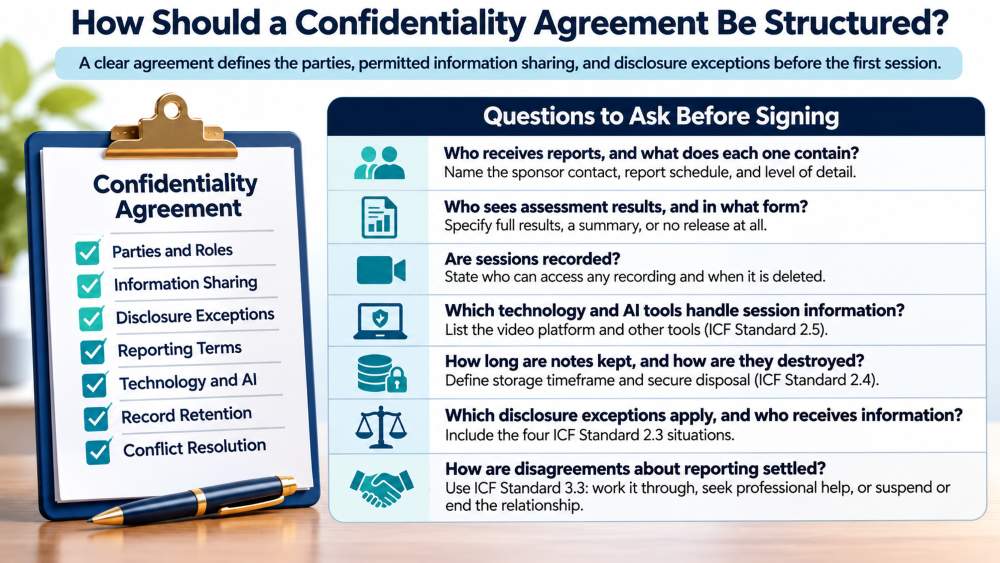
A confidentiality agreement names every party, assigns each category of information to its permitted recipients, and lists the disclosure exceptions before the first session.
ICF Standards 1.1, 2.2, 2.3, 2.4, 2.5, 3.2, and 3.3 cover these terms for ICF Professionals, and other coaches can use the same standards as a model.
Questions to Ask Before Signing
- Who receives reports, and what does each one contain? The answer should name the sponsor contact, the report schedule, and the level of detail.
- Who sees assessment results, and in what form? Full results, a summary, and no release at all are three different terms.
- Are sessions recorded? The agreement should say who can access any recording and when it is deleted.
- Which technology and AI tools handle session information? ICF Standard 2.5 covers technology duties, and sessions at the practice run through virtual coaching so the video platform should be listed.
- How long are notes kept, and how are they destroyed? ICF Standard 2.4 asks for storage and disposal procedures that keep records private and secure.
- Which disclosure exceptions apply, and who receives information under each one? The four ICF Standard 2.3 situations give this clause its starting list.
- How are disagreements about reporting settled? ICF Standard 3.3 lists working the conflict through with the parties, seeking professional help, or suspending or ending the relationship.
Sample Sponsor Reporting Arrangement
In a sample employer-funded engagement, the sponsor joins one goal-setting meeting and approves the stated goals. The leader shares attendance and a quarterly progress note on those goals with the sponsor.
Session content and themes stay between the leader and coach, and the sponsor receives assessment results only if the leader signs a release. Either party can reopen the reporting terms at a scheduled review.
Terms Specific to the Practice
The Discover-Achieve process in the practice’s executive coaching approach starts with assessments, so the release terms for results may come up early in an engagement.
Most engagements at the practice run three to twelve months. Session discussions at the practice stay with the client: Marilyn Fettner keeps client confidentiality and does not pass anything said in a session to an employer, a board, or any other outside party, other than what is stipulated in the agreement, is agreed to in writing by the client, or includes a threat of harm.
Frequently Asked Questions
Can an employer see what is said in executive coaching?
An employer’s access to session content depends on the coaching agreement and any applicable legal requirements. For ICF Professionals, the ICF Code treats coaching information as protected unless a legal requirement, a threat of harm, or the client’s written consent supports releasing it.
Does an executive coach send progress reports to the leader’s manager?
An executive coach sends progress reports only when the coaching agreement includes reporting. ICF Standard 3.2 lists reporting requirements among the items ICF Professionals manage through the agreement, so the timing, recipients, and level of detail of any report belong in writing.
Does counselor privilege cover executive coaching in Illinois?
Illinois law, at 225 ILCS 107/75, makes information that licensed professional counselors and clinical professional counselors receive in their professional capacity privileged. Coaching carries no state license in Illinois. Whether that statute reaches any coaching conversation is a legal question for an Illinois attorney.
Can an executive coach be subpoenaed?
ICF Standard 2.3 asks ICF Professionals to agree with clients and sponsors, before coaching begins, on what may be disclosed under a court order or subpoena. The agreement records that understanding, while how a court treats a particular subpoena is a question for an attorney.
Are 360 feedback results confidential?
360 feedback results follow the release terms in the coaching agreement. At Fettner Executive & Professional Career Coaching, the LEA 360 gathers ratings from peers, direct reports, and supervisors on 22 leadership practices, and the leader reviews results with the coach in a structured debrief.
What is a coaching sponsor?
A coaching sponsor is the person or organization that pays for, arranges, or defines coaching services, according to the ICF Code of Ethics. ICF Standard 1.1 asks the coach to establish an agreement with both the client and the sponsor that covers roles, responsibilities, and confidentiality.
What happens to coaching notes after the engagement ends?
ICF Standard 2.4 asks coaches to store and later destroy records, digital files, and messages in ways that keep them private and secure, consistent with law and the agreement. The agreement can also state how long coaches keep notes and how they destroy them.
Can an executive coach use AI tools with session information?
ICF Standard 2.5 asks coaches to meet their ethical and legal duties when they use technology, including artificial intelligence software, platforms, and data stores. A leader can ask the coach to list in the agreement which tools handle session information and how it stays protected.
Can reporting terms change during an engagement?
In employer-sponsored coaching, reporting terms change when the agreement is revised. ICF Standard 3.2 has ICF Professionals manage conflicts with clients and sponsors through the agreement and ongoing dialogue, and Standard 3.3 allows suspending or ending the relationship when a conflict cannot be worked through.
Bottom Line
A sponsoring employer sees what the coaching agreement assigns to it, and the ICF Code binds only coaches who present themselves as ICF members or credential holders.
Clinical privilege for Illinois counselors comes from 225 ILCS 107/75 and its listed release routes.
A practical step for any leader is to ask the seven questions above and read the confidentiality clause before the first session.
Leaders ready to settle reporting terms before coaching begins can discuss coaching confidentiality with Fettner Executive & Professional Career Coaching today.