
Executive and Leadership Coaching With a Licensed Clinician: How an LCPC Credential Can Strengthen the Outcome
Executive coaching with a licensed clinician is leadership coaching delivered by a coach who also holds a state clinical counseling license.
That graduate training adds a psychological lens: it helps explain why a capable leader stalls, avoids a hard conversation, or reacts badly under pressure, so the coaching plan targets the cause, not just the visible behavior.
The engagement is still executive coaching built on goals. The client sets those goals, progress is measured against them, and coaching stays separate from therapy.
Key Takeaways
- Illinois licenses clinical professional counselors under 225 ILCS 107/45, which requires a qualifying graduate degree and two years of full-time supervised clinical work.
- The Illinois Department of Financial and Professional Regulation (IDFPR) also requires passing scores on the National Counselor Examination (NCE) and National Clinical Mental Health Counseling Examination (NCMHCE), or on the Certified Rehabilitation Counselor Examination (CRCE).
- The National Board for Certified Counselors (NBCC) developed both the NCE and NCMHCE, which licensing boards in all 50 states use.
- The National Career Development Association (NCDA) awards the Certified Career Counselor (CCC) credential to counselors with a master’s or higher plus career development training.
Leaders who want coaching beyond surface skills can schedule a consultation with Fettner Executive & Professional Career Coaching in Northbrook, Illinois, to discuss their goals.
What Does a Clinical License Add to Executive Coaching?
A clinical license adds depth to executive coaching. A licensed coach has completed graduate study in counseling and years of supervised practice in understanding how people think, feel, and act, then applies that understanding to leadership goals.
That background shows up in three ways during an engagement:
- Seeing what drives a pattern. Clinical education covers motivation, human development, and how stress and past experience shape decisions. A coach with that grounding can work out why the same problem keeps returning at work.
- Listening for what sits underneath. Supervised clinical practice trains a counselor to hear what a client’s first explanation leaves out. The counselor then asks the question that brings it into the open.
- Holding candid conversations safely. Licensed counselors work under a professional code of ethics covering confidentiality and boundaries. Executives can then speak openly about pressures they rarely raise inside their organizations.
Illinois sets the bar for that training in law. Under 225 ILCS 107/45 of the Professional Counselor and Clinical Professional Counselor Licensing and Practice Act, an LCPC applicant needs a qualifying master’s or doctoral degree in counseling, psychology, rehabilitation counseling, or an approved related field. The applicant also needs two years of full-time clinical counseling work under a qualified supervisor.
The IDFPR licensure qualifications add an exam step: passing scores on both national counselor exams, or on the CRCE. IDFPR’s role continues after the license is granted, through renewal and continuing education rules, public complaints, and discipline up to revocation.
Marilyn Fettner, LCPC, CCC, NCC, CPVC, holds an Illinois LCPC license, and the state can confirm her counseling credentials directly. She pairs that clinical training with more than 25 years of executive and professional coaching.
How Does the LCPC Compare With Other Coaching and Counseling Credentials?
The LCPC is the only credential in this comparison that a state issues, and the only one that authorizes clinical practice. The NCC and CCC are national credentials from professional bodies, while coaching-only certificates come from private programs.
| Credential | Issued by | Core requirements | What it confirms for a client | How to verify |
| LCPC (Illinois) | Illinois Department of Financial and Professional Regulation (state agency) | Qualifying master’s or doctoral degree; two years of full-time supervised clinical work; NCE and NCMHCE (or CRCE) | State-reviewed clinical training, renewal and continuing education rules, and a public complaint process | IDFPR license lookup |
| NCC | National Board for Certified Counselors | Graduate counseling degree of at least 48 semester hours; supervised post-master’s experience; NCE or NCMHCE | Counseling training measured against a national standard | NBCC Counselor Verify |
| CCC | National Career Development Association | Master’s or higher in counseling; career development specialty training; competency assessment | Counseling education plus a specialty in career development | NCDA |
| Coaching-only certificate | Private training programs and coaching associations | Varies; usually coach training and logged coaching hours, no counseling degree | Training in coaching methods, without clinical education or state oversight | Varies by program |
NBCC sits close to the center of counselor licensure. The board developed and owns both exams that licensing boards in all 50 states use, while each state issues the license itself.
NBCC’s eligibility policy sets the NCC experience bar at 3,000 supervised post-master’s hours over at least 24 months. State-licensed counselors and graduates of CACREP-accredited programs are exempt from that requirement.
NCDA’s credentialing page lists three routes to the CCC career specialty: 600 supervised career counseling hours, 60 approved continuing education units, or the Facilitating Career Development course. Every CCC applicant also completes a competency assessment and four case studies.
Coaching itself carries no state license in Illinois. The state’s counseling law protects counselor titles but sets no standard for the word “coach,” so anyone can advertise career coaching, executive coaching, or leadership coaching with nothing behind the title.
Fettner holds all three counseling credentials in the table and belongs to both NBCC and NCDA. Her clients get clinical depth and long coaching experience from the same practitioner.
What Does Clinical Training Change Inside a Coaching Session?
Clinical training changes how far a coach looks into what a client brings in. The coaching goals stay the same, but the coach sees more clearly what is blocking them, so session time goes to what will move the work forward.
The NCMHCE, one of the exams Illinois accepts for licensure, includes 11 clinical case studies designed to replicate real counseling work. Passing it shows sound judgment about people, and Fettner applies that judgment in four ways:
- Finding the real driver. A leader who freezes before board presentations may have a skills gap, a confidence pattern, or something more. Clinical training gives Fettner a framework for telling these apart, so leadership development work aims at the cause she and the client identify together.
- Knowing when coaching is the wrong tool. Clinical programs teach the signs that an issue needs a different kind of support. In Fettner’s experience, that training brings a mismatch to light sooner than a performance-only view does.
- Using validated assessments well. Publishers of psychometric instruments set certification rules for who may administer and interpret them. Fettner is certified in the CPI 260, MBTI, Highlands Ability Battery, and other instruments she uses with clients.
- Changing the plan when the evidence points elsewhere. An organization flagged a director for a communication skills problem: staying silent in meetings. A skills-first plan would have drilled presentation technique for a quarter. In week two, Fettner spotted an avoidance pattern tied to an earlier incident and moved the plan toward that pattern, while keeping the work focused on performance.
Where Does Coaching Stop and Clinical Work Begin?
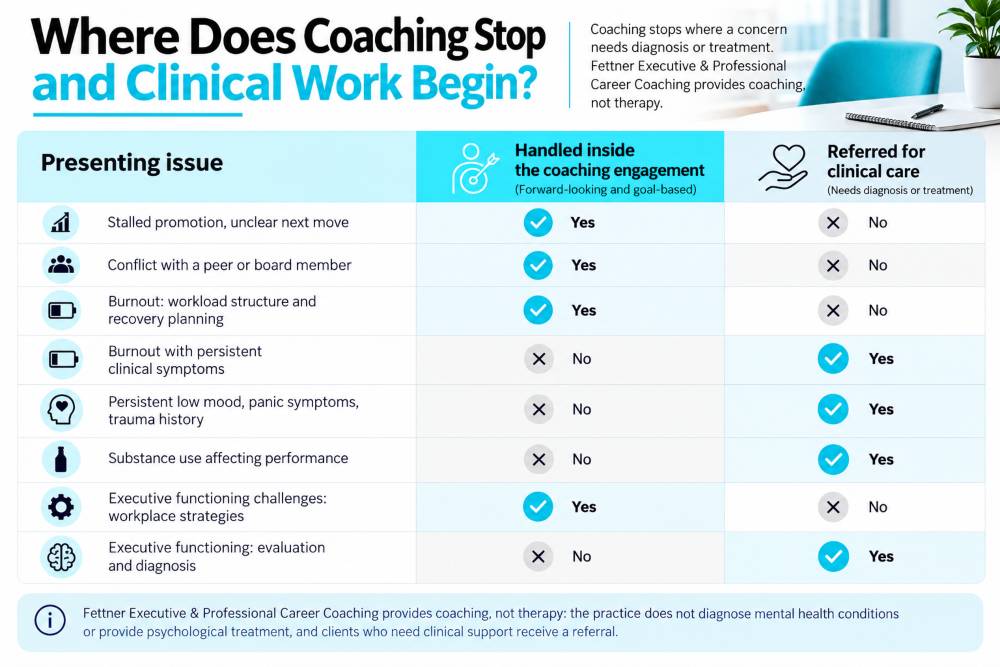
Coaching stops where a concern needs diagnosis or treatment. Fettner Executive & Professional Career Coaching provides coaching, not therapy: the practice does not diagnose mental health conditions or provide psychological treatment, and clients who need clinical support receive a referral.
Personal issues that come up during an engagement may fit executive life coaching when the work is forward-looking and goal-based. Those issues move to clinical care only when they need clinical intervention, as the table below shows.
| Presenting issue | Handled inside the coaching engagement | Referred for clinical care |
| Stalled promotion, unclear next move | Yes | No |
| Conflict with a peer or board member | Yes | No |
| Burnout: workload structure and recovery planning | Yes | No |
| Burnout with persistent clinical symptoms | No | Yes |
| Persistent low mood, panic symptoms, trauma history | No | Yes |
| Substance use affecting performance | No | Yes |
| Executive functioning challenges: workplace strategies | Yes | No |
| Executive functioning: evaluation and diagnosis | No | Yes |
Leaders unsure whether a problem is behavioral or clinical can book a confidential, complimentary 30-minute consultation with Marilyn at Fettner Executive & Professional Career Coaching.
Which Leadership Challenges Benefit Most From a Clinically Trained Coach?
Clinical training helps most with four kinds of leadership challenges: performance problems with an unclear cause, executive functioning challenges, stress that has become hard to manage, and high-stakes decisions weighed down by emotional strain.
Problems Where Finding the Real Cause Shapes the Plan
A senior leader missing deadlines may have a prioritization problem, or an executive functioning difference that has gone unaddressed for years. Performance coaching built on the wrong assumption can waste months of effort.
Clinical training guides how Fettner works through that first identification step with a client. Executive functioning work then follows her ADHD coaching model, using practical workplace strategies and keeping the work within coaching.
Problems Where Emotional Strain Clouds Judgment
Long stretches of overload erode decision quality well before a performance review picks it up. Stress management coaching addresses the workload and habits behind that overload, and clinical training helps Fettner notice when stress has gone beyond the situation at hand.
Leaders facing board appointments, restructurings, or succession choices also benefit from coaching focused on sound decision-making. One goal of that coaching is to separate the decision from the anxiety around it.
How Can a Coach’s License Be Verified?
An Illinois clinical license can be checked online without asking the coach. IDFPR’s license lookup lets anyone confirm whether a professional holds an Illinois license.
NBCC runs a separate register, Counselor Verify, where anyone can check that an NCC holder’s certification is current. Both registers are open to the public.
Checking credentials takes less effort than any other step in choosing a coach. The coaching approach a client signs up for should rest on credentials that can be confirmed, not on description alone.
Frequently Asked Questions
What does a licensed clinician add to executive coaching?
A licensed clinician adds graduate training in human behavior and supervised experience in understanding what drives people. In executive coaching, that lens helps identify why a leader is stuck, so the coaching plan can address the underlying pattern instead of only the visible behavior.
Is an executive coach who is a licensed counselor the same as a therapist?
No, an executive coach who is a licensed counselor provides coaching, not therapy. The license reflects verified clinical training and state oversight, while the engagement stays focused on leadership performance, career decisions, and the client’s goals, with clinical concerns referred to outside care.
What does the LCPC license require in Illinois?
Illinois requires a qualifying master’s or doctoral degree and two years of supervised clinical work for the LCPC license. Applicants must also pass the National Counselor Examination and the National Clinical Mental Health Counseling Examination, or the Certified Rehabilitation Counselor Examination, before IDFPR issues it.
What is a Certified Career Counselor?
A Certified Career Counselor holds the CCC credential from the National Career Development Association. The credential requires a master’s or higher in counseling, career development specialty training, a competency assessment, and four case studies, and it signals depth in career and professional decisions.
What is the difference between an NCC and an LCPC?
An NCC is a voluntary national certification from the National Board for Certified Counselors, while an LCPC is an Illinois state license. Only the LCPC authorizes independent clinical practice in Illinois, though both require graduate counseling education and passing a national counselor examination.
Does Illinois require a license to work as an executive coach?
No, Illinois does not license executive coaches. The state’s counseling law protects counselor titles but sets no standard for the word coach, so a coach may have no counseling education. A state license or national certification gives clients a verifiable record of training.
How can a coach’s clinical license be verified?
A coach’s Illinois clinical license can be verified through the IDFPR license lookup, which confirms whether a professional holds an Illinois license. The National Board for Certified Counselors runs a separate public register, Counselor Verify, for checking that a National Certified Counselor’s certification is current.
What happens when a coaching issue turns out to be clinical?
A clinically trained coach recognizes the shift and names it directly with the client. At Fettner Executive & Professional Career Coaching, that leads to a referral for clinical care, and coaching then either pauses or continues alongside that care, focused only on performance goals.
Bottom Line
A clinically trained coach brings graduate training in human behavior to leadership work while keeping coaching separate from therapy.
In Illinois, the LCPC license requires a qualifying graduate degree, two years of supervised clinical work, and national exams developed by NBCC, all overseen by the IDFPR.
Paired with more than 25 years of executive coaching, that training helps a coach see past the surface of a problem and build a plan aimed at its cause.
Leaders who want a coach with checkable credentials can start with a confidential call to Fettner Executive & Professional Career Coaching before the first session.