
Leadership Coach or Therapist? Choosing the Right Approach for Leadership Challenges
An executive coach partners with an executive to clarify their goals and develop them into a plan which the client will execute with the support of their coach. Conversely, therapy addresses mental health concerns and is provided by a licensed clinical provider.
A leadership problem that resolves through a plan and a change in managerial approach commonly belongs in executive coaching.
Key Takeaways
- A useful starting evaluation is determining what the problems suggest: improvement in leadership behaviors/skills suggests coaching; clinical problems suggest therapy with a licensed provider.
- Coaching and therapy can run simultaneously, under separate agreements with separate providers.
Leaders unsure which service their situation calls for can settle that question with Fettner Executive & Professional Career Coaching — schedule a consultation.
What Separates Coaching From Therapy in Practice?
Coaching is organized around a goal the client and coach clarify and set a plan to achieve that goal, which the client carries out with support of the coach. The International Coaching Federation defines coaching as partnering with clients in a process aimed at maximizing personal and professional potential—a definition built on partnership and forward movement rather than treatment. Therapy is organized around clinical need identified by a licensed provider.
| Dimension | Coaching | Therapy |
| Organizing question | What outcome does the client want, and what actions get them there | What clinical need is present, and what treatment addresses it |
| Time orientation | Forward — the next decision, role, or change in approach | Includes history where clinically relevant |
| Who sets the agenda | The client and coach, through a coaching agreement | The provider, through a clinical plan, in collaboration with the client |
| Provider regulation | No national or state license required to practice as a coach | Illinois restricts both the protected counselor titles and the rendering of counseling services without a license, under 225 ILCS 107 |
| Accountability route | Professional associations, where the coach holds a credential | State regulator, with complaint and discipline authority |
| How the engagement ends | Goals met, or client terminates | Treatment goals met, or client terminates |
The table describes how each service is typically organized, not an exclusive division of subject matter.
Illinois statute makes the overlap explicit: the definitions in 225 ILCS 107/10 describe professional counseling as including assistance with relationships, conflicts, problem solving, decision making, and developmental concerns.
A leader working on conflict with a board member may be engaged in coaching, where the objective is a communication strategy, and in clinical work when a mental health concern contributes to distress. The same presenting problem can legitimately be approached from either direction.
Which Leadership Problems Are Coaching Problems?
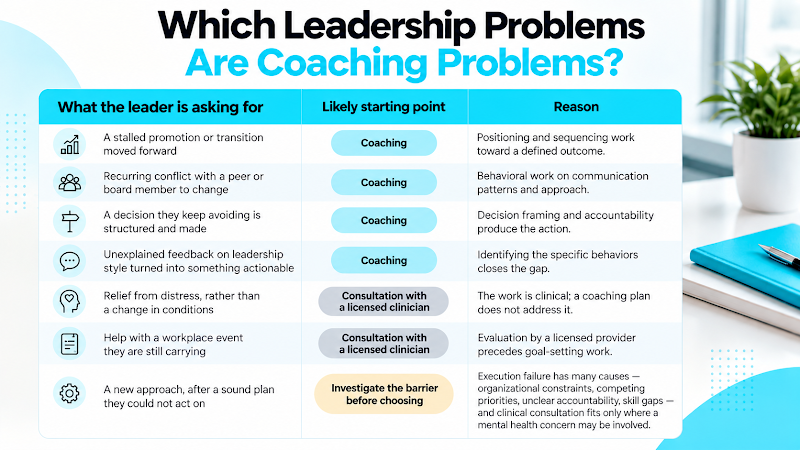
Situations indicate coaching when a leader’s goals suggest that a plan, with steps they can initiate, will address the problem. The table below lists various leadership problem situations.
| What the leader needs | Likely starting point | Reason |
| A stalled promotion or transition moved forward | Coaching | Positioning and sequencing work toward a defined outcome |
| Recurring conflict with a peer or board member | Coaching | Behavioral work on communication patterns and approach |
| A decision they keep avoiding | Coaching | Decision framing and accountability produce the action |
| Unexplained feedback on leadership style | Coaching | Identifying the specific behaviors closes the gap |
| Relief from distress | Consultation with a licensed clinician | The work is clinical; a coaching plan does not address it |
| Help with a workplace situation that has lingering distress | Consultation with a licensed clinician | Evaluation by a licensed provider precedes goal-setting work |
| A new approach, after having a sound plan they could not execute | Investigate the barrier before choosing | Execution failure has many causes — organizational constraints, competing priorities, unclear accountability, skill gaps — and clinical consultation fits only where a mental health concern may be involved |
In Fettner’s practice, the situations leaders bring most often sit in the top half of that table. Leadership development work, promotion strategy, and interpersonal pattern change are coaching problems, and they remain coaching problems regardless of how senior the leader is or how long the difficulty has persisted. Difficulty and duration are not themselves clinical indicators.
A misrouted engagement costs months of progress; Fettner Executive & Professional Career Coaching sorts coaching questions from clinical ones at intake — book a call.
Which Problems Belong With a Clinical Provider?
Mental health concerns belong with a licensed clinical provider, and that routing doesn’t necessarily depend on severity or how the concern presents at work.
Illinois reserves clinical practice to licensed practitioners under the Professional Counselor and Clinical Professional Counselor Licensing Act, administered by the Illinois Department of Financial and Professional Regulation.
A coaching engagement operates outside that authority, regardless of the coach’s credentials, and only a licensed provider can determine whether clinical need is present.
What Happens When a Coaching Engagement Surfaces a Clinical Issue?
The engagement does not quietly become something else. Professional ethics standards require the practitioner to name the mismatch and act on it, which means a referral rather than a broader coaching agreement.
The obligations come from two separate codes governing two separate groups. The ICF Code of Ethics, in effect since April 2025, binds ICF members and credential-holders; Standard 4.3 requires remaining alert to shifts in the value a client receives, discussing them, and exploring the potential for a different coach, professional, or resource.
The NBCC Code of Ethics binds counselors certified by the National Board for Certified Counselors rather than coaches generally, directing them to perform only services for which they are qualified and to facilitate a referral where there is reasonable cause to believe the client will not benefit.
A coach holding both a coaching credential and a counseling certification answers to both.
Fettner’s own approach to a referral runs in three steps. The first names what has surfaced in plain terms, without labeling it.
The second identifies the type of provider the situation calls for, rather than leaving the leader to search unaided.
The third is a decision, with the client, whether the coaching engagement pauses or continues on separate goals — a leader working through a role transition may keep the transition work running while clinical care proceeds elsewhere.
The duty to refer is common to both codes; those three steps are how Marilyn Fettner carries it out, and her clinical training shapes how early the conversation happens and how specific the referral can be.
Can Both Run at the Same Time?
Yes, and senior professionals do engage in both, as needed. A client may work with a clinician on clinical concerns while working with a leadership coach on a promotion case, a board transition, or a team dynamic, because the two engagements answer different questions under different agreements.
Two conditions keep that arrangement clean. The first is role clarity: ICF Standard 3.7 recognizes that practitioners often hold multiple professional roles based on prior training, and requires disclosure to the client when the practitioner is acting in a capacity other than coach.
One practitioner should not deliver both services to the same client without making that distinction explicit.
The second is scope discipline on the coaching side. Performance coaching running alongside clinical care stays on performance goals, and executive life coaching stays on forward-looking personal goals, with clinical material belonging to the clinical provider.
Coordination between the two providers depends on the client’s consent and on each provider’s own professional obligations.
Frequently Asked Questions
How do I know if I need coaching or therapy?
Start with what the work needs to accomplish. A goal that converts into a plan that the leader executes usually points to coaching.
Can a person do coaching and therapy at the same time?
Yes. Many professionals work with a therapist on clinical concerns while working with a coach on career and leadership goals. The two engagements run in parallel under separate agreements with separate providers, and coordination between them depends on the client’s consent.
Who decides whether a situation is a coaching problem or a clinical one?
A client chooses which service to seek, but a client does not determine clinical need. Provider scope and professional judgment govern that, and a coach bound by professional ethics must discuss fit and facilitate a referral when the service offered does not match.
Does executive coaching ever turn into therapy?
No. A coaching engagement stays a coaching engagement. When clinical material surfaces, the ethical response is to refer to a licensed provider rather than expand the coaching scope agreed to at the outset, even when the coach also holds a clinical license.
Can a coach tell whether a situation is clinical?
A coach can recognize when a situation falls outside coaching and must say so under professional ethics standards. A coach does not perform clinical assessment or diagnosis, so the response is a referral rather than an evaluation.
Does coaching work for burnout?
Coaching addresses the workload patterns, personal and professional boundaries, and role design that contribute to burnout. Burnout also has clinical dimensions, so a consultation with a licensed provider may be appropriate alongside or before coaching.
Is a coach allowed to recommend therapy?
Yes, and professional ethics standards expect it. The ICF code directs coaches to discuss a shift in value and explore other professionals or resources, and the NBCC code places parallel referral duties on its certified counselors when the service offered will not serve the client.
What if a leader is unsure which service applies?
Starting with either an intake conversation with a coach or a consultation with a licensed clinician clarifies the question quickly. Both professionals operate under ethics codes requiring a referral when the presenting situation falls outside the service being offered.
Bottom Line
What the leader needs the work to accomplish is the most useful starting question. A goal that becomes a plan the leader can execute points toward coaching—stalled transitions, interpersonal conflict, avoided decisions, unexplained feedback. However, when situations have more deeply entrenched long standing issues, therapy may be more appropriate.
The two fields can appear on the surface to overlap in subject matter, which is why an evaluation by a trained professional is needed. Often, executives will engage in both leadership coaching and therapy. In these situations, coaching and clinical care can run in parallel under separate agreements, with separate providers.
Ethics standards require a coach to raise the question of fit rather than leaving the leader to work it out alone.
Clarity about which professional to see is worth one conversation; Fettner Executive & Professional Career Coaching offers that conversation first — start the discussion.