
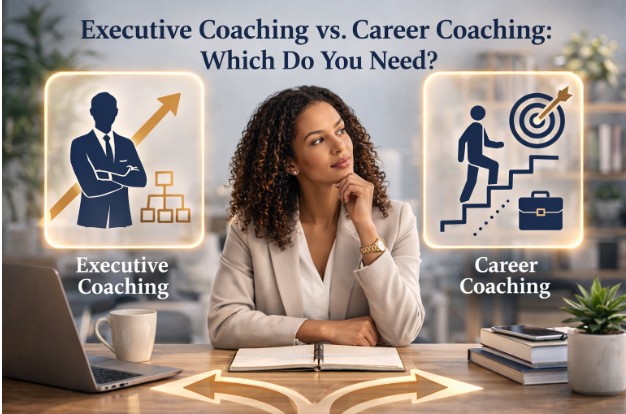
Executive Coaching vs. Career Coaching: Which Do You Need?
Executive coaching targets leadership performance within a current senior role. Career coaching focuses on career direction and job search strategy for professionals transitioning to a new role. The right choice depends on where your primary challenge lies — inside or outside your current position.
A professional who cannot get their leadership team aligned needs a different intervention than a professional who does not know which team to lead next.
Marilyn Fettner, LCPC, CCC, NCC, CPVC, offers both services through Fettner Executive & Professional Career Coaching in Northbrook, Illinois, and this guide clearly distinguishes between them so you can choose the right one.
Key Takeaways
- Executive coaching targets leadership performance, interpersonal effectiveness, and organizational impact for C-suite executives, VPs, and senior-level professionals operating in high-stakes roles.
- Career coaching targets career direction, job search strategy, role transitions, and professional market positioning for professionals at any career stage.
- Marilyn Fettner delivers both services one-on-one through Fettner Executive & Professional Career Coaching in Northbrook, Illinois, and offers virtual services to professionals in all 50 U.S. states.
- The correct service depends on the nature of your current challenge — internal leadership performance or external career direction — not on your job title.
What Is Executive Coaching?
Executive coaching is a confidential, one-on-one leadership development process designed for C-suite executives, senior vice presidents, and high-performing professionals who manage teams and organizational budgets in senior-level roles.
Marilyn Fettner, LCPC, CCC, NCC, CPVC — a Licensed Clinical Professional Counselor and certified executive coach based in Northbrook, Illinois — delivers executive and leadership coaching through individualized sessions grounded in six clinical assessment instruments: the CPI 260, MBTI, FIRO-B, TKI, Highlands Ability Battery, and LEA 360.
Each executive coaching engagement begins with a structured needs assessment and proceeds through targeted sessions calibrated to the leader’s specific performance challenges.
Executive coaching engagements run 3–12 months and adjust based on documented progress and shifting organizational priorities — no packaged program governs the timeline.
Marilyn Fettner’s clinical licensure as an LCPC distinguishes executive career coaching at Fettner Executive & Professional Career Coaching from standard coaching programs.
A Licensed Clinical Professional Counselor is trained to address the psychological dimensions of leadership dysfunction — including executive burnout, identity disruption during role transitions, emotional reactivity under board-level pressure, and interpersonal conflict within senior leadership teams — that a certified coach without clinical training is not licensed to treat.
What Is Career Coaching?
Career coaching is a structured, one-on-one professional development process for individuals navigating career transitions, active job searches, role changes, promotions, and deliberate career pivots.
Career coaching serves professionals across all career stages — including recent graduates entering competitive job markets, mid-career professionals repositioning after a layoff, and senior executives considering a sector change — with a focus on clarifying direction, developing a competitive positioning strategy, and building the tactical tools needed to move forward.
Career coaching services at Fettner Executive & Professional Career Coaching cover career direction strategy, job search planning, personal brand development, resume positioning, interview preparation, and career advancement planning at every professional level.
All sessions are one-on-one, individualized to each client’s goals, and delivered virtually. Fettner Executive & Professional Career Coaching offers no group programs and no recorded courses.
Career coaching serves professionals whose primary challenge is external — determining where to go next, how to position their experience for a target role, and how to execute a competitive search — rather than improving leadership performance in their current role.
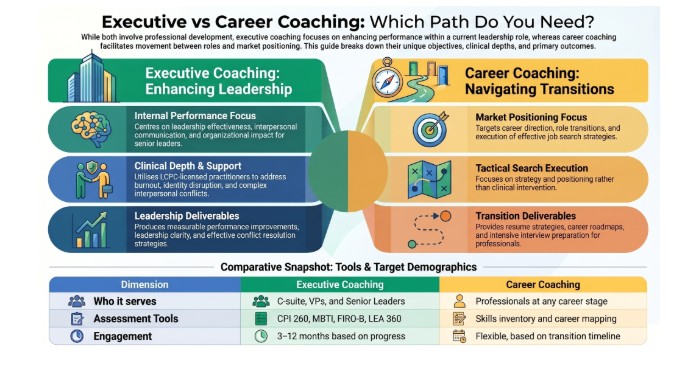
Executive Coaching vs. Career Coaching: A Direct Comparison
| Dimension | Executive Coaching | Career Coaching |
| Primary focus | Leadership performance, interpersonal effectiveness, organizational impact | Career direction, role transitions, job search execution, market positioning |
| Who it serves | C-suite executives, VPs, senior leaders in high-stakes roles | Professionals at any career stage |
| Core challenge | How the leader performs, manages, and communicates within the current role | Where the professional goes next and how to reach that target |
| Assessment instruments | CPI 260, MBTI, FIRO-B, TKI, Highlands Ability Battery, LEA 360 | Skills inventory, values clarification, and career mapping tools |
| Engagement length | 3–12 months, individualized and adjusted to documented progress | Flexible, structured around the client’s specific transition timeline |
| Clinical depth | LCPC-licensed — addresses burnout, identity disruption, interpersonal conflict | Coaching-focused — strategy, positioning, and search execution |
| Primary deliverables | Leadership clarity, performance improvement, and conflict resolution | Resume strategy, job search plan, career direction roadmap, interview preparation |
Who Needs Executive Coaching?
Executive coaching serves senior leaders who face challenges requiring deeper self-awareness, stronger interpersonal judgment, or sustained behavioral change under sustained organizational pressure.
Job title does not determine fit — the defining question is whether the challenge originates inside the role rather than outside it.
Strong candidates for executive and leadership coaching share recognizable patterns. A leader who has stepped into a larger role and finds that the interpersonal complexity has outpaced their prior experience needs executive coaching to build the relational range the new scope requires.
A senior professional receiving consistent feedback on their leadership style — but unable to identify the specific behaviors driving it — needs executive coaching to close the gap between intent and impact.
A VP or C-suite executive whose team is underperforming and suspects that a leadership dynamic is a contributing factor needs executive coaching to identify and correct the specific driver before performance deteriorates further.
A leader managing sustained high-pressure conditions and observing the effects on judgment, key relationships, or decision-making quality needs executive coaching. A senior executive preparing for a C-suite transition who wants structured development support before the transition — not reactive support after problems surface — needs executive coaching.
Performance coaching for senior professionals focuses on measurable improvements in output, interpersonal effectiveness, and team leadership dynamics.
Marilyn Fettner integrates all three dimensions into a single engagement when the client’s situation requires it, so you can address performance, relationships, and leadership identity within one structured process.
Who Needs Career Coaching?
Career coaching serves professionals who require strategic clarity about their next move, targeted support during a job search or role transition, or structured help in building the visible market positioning that makes them competitive for target roles.
The core challenge is directional and external — focused on what the professional does next and how they present to the market.
Career coaching through Fettner Executive & Professional Career Coaching fits the following professional situations.
Professionals re-entering the workforce after a career gap or significant life transition — including caregiving leave, health interruption, or relocation — use career coaching to rebuild competitive positioning.
Professionals experiencing a mid-career shift use career coaching to translate accumulated experience into a clearly defined new direction, so they can enter a target sector with a credible narrative rather than an unfocused resume.
Professionals preparing for an internal promotion use career coaching to sharpen their advancement case. Professionals building a job search strategy after an involuntary separation use career coaching to accelerate reentry timelines.
The career decision-making framework Marilyn Fettner applies with senior professionals treats career transitions as high-stakes strategic exercises — not administrative resume updates — because executive-level career moves carry financial, reputational, and long-term trajectory consequences that require that depth of analysis.
When Executive Coaching and Career Coaching Are Both Required
Two professional situations require that both services be delivered simultaneously or in a deliberate sequence. A C-suite executive leaving a senior operating role to pursue a board directorship, for example, faces two simultaneous challenges: an internal leadership identity transition and an external positioning and search challenge.
Marilyn Fettner structures combined engagements that address executive coaching and career coaching dimensions within a single relationship, so the client does not receive partial support from two separate providers who lack visibility into the full picture.
Professionals who are uncertain whether their situation calls for executive coaching, career coaching, or a combined approach can consult the “need for an executive coach assessment” page, which catalogs the most common triggers in detail.
Fettner Executive & Professional Career Coaching also evaluates fit directly in a free 30-minute discovery consultation and clearly identifies when a different resource would produce better outcomes.
How Marilyn Fettner Delivers Executive Coaching and Career Coaching
Marilyn Fettner, LCPC, CCC, NCC, CPVC, is a Licensed Clinical Professional Counselor, National Certified Counselor, Career Development Facilitator, and Certified Professional Vocational Counselor with 25+ years of practice and more than 3,000 individual clients coached across executive leadership and career development engagements.
Fettner’s dual qualifications — clinical licensure as an LCPC and professional certification as a career and executive coach — enable her to bring both psychological diagnostic depth and strategic career precision to every engagement, whether the client’s primary challenge is a leadership performance issue or a career direction question.
Marilyn Fettner holds certification in six assessment instruments — CPI 260, Highlands Ability Battery, FIRO-B, MBTI, TKI, and LEA 360 — and uses each to ground coaching recommendations in objective data rather than subjective impressions, so you can make high-stakes leadership and career decisions with a factual evidence base.
Fettner Executive & Professional Career Coaching delivers all sessions as fully confidential, one-on-one virtual appointments available to professionals in all 50 U.S. states. The firm maintains no group programs, no recorded courses, and no organizational reporting obligations to employers or third parties.
Schedule a free 30-minute consultation with Fettner Executive & Professional Career Coaching to identify the right service for your current professional challenge.
Frequently Asked Questions
What is the difference between executive coaching and career coaching?
Executive coaching and career coaching address different professional challenges. Executive coaching targets leadership performance, interpersonal effectiveness, and organizational impact for senior leaders in their current roles. Career coaching targets career direction, role transitions, job search strategy, and market positioning for professionals at any career stage.
Can a C-suite executive benefit from career coaching?
Yes. A C-suite executive transitioning out of a senior operating role, considering a deliberate career pivot, or pursuing a board directorship benefits from career coaching delivered alongside or following an executive coaching engagement. Executive coaching and career coaching address different dimensions and work effectively together when both are active simultaneously.
How do I determine whether I need executive coaching or career coaching?
Professionals whose primary challenge lies in how they lead, manage, or perform in their current role need executive coaching. Professionals whose primary challenge involves where to go next, how to position prior experience, or how to execute a competitive job search need career coaching. Professionals facing both challenges simultaneously benefit from a combined engagement.
Does Marilyn Fettner deliver both executive coaching and career coaching?
Yes. Marilyn Fettner offers executive and career coaching through Fettner Executive & Professional Career Coaching in Northbrook, Illinois. All services are virtual, one-on-one, and available to professionals in all 50 U.S. states.
How long does executive coaching take compared to career coaching?
Executive coaching engagements at Fettner Executive & Professional Career Coaching run 3–12 months, with adjustments based on the individual leader’s goals and documented progress. Career coaching timelines vary by engagement type — a focused job-search engagement follows a different timeline than a long-term career-pivot process. Both service types are structured around individual client goals rather than a fixed program schedule.
What credentials should an executive coach hold?
A qualified executive coach holds recognized professional certifications — such as CCC, NCC, or CPVC — and ideally holds clinical licensure, such as LCPC, for work addressing the psychological dimensions of leadership. Certification in assessment instruments such as the CPI 260, MBTI, FIRO-B, and Highlands Ability Battery signals a data-grounded coaching methodology.
Is executive coaching confidential?
Executive coaching through Fettner Executive & Professional Career Coaching is fully confidential. Marilyn Fettner shares nothing discussed in sessions with the client’s employer, board, organization, or any third party. This independence from organizational reporting obligations is a structural requirement for the coaching relationship to function effectively.
What occurs during a free consultation with Fettner Executive & Professional Career Coaching?
The free 30-minute discovery consultation is a direct, one-on-one conversation between the prospective client and Marilyn Fettner. Fettner uses the consultation to assess whether executive coaching, career coaching, or a combined engagement best matches the client’s situation — and to communicate clearly when a different resource would yield better outcomes.