
Executive Coaching for Women in Leadership: Navigating the C-Suite as a Female Executive
Executive coaching supports women in the C-suite to succeed, by expanding the range of leadership tools available to an already accomplished leader.
The work targets influence, executive presence, assertive communication, and stakeholder strategy inside a specific organizational environment.
Executive coaching at Fettner Executive & Professional Career Coaching begins with assessment data, then builds a plan around the situation the leader is actually operating in rather than a general model of executive behavior.
Key Takeaways
- Women hold 29% of C-suite roles, unchanged between 2024 and 2025, according to the Women in the Workplace study by LeanIn.Org and McKinsey.
- Research published in the Journal of Applied Psychology in February 2026 found that the penalty women face for assertive behavior weakened as perceived competence rose, disappearing at higher levels.
- Coaching for this population is calibrated to one organization’s dynamics, so the same leader may need different tools in a different company.
Accomplished executives can lose influence with problems that competence alone does not resolve. Fettner Executive & Professional Career Coaching addresses that gap directly — schedule a consultation.
How Can Executive Coaching Help Women Succeed in the C-Suite?
Executive coaching helps women succeed in the C-suite by building influence, presence, assertive communication, and stakeholder strategy calibrated to the organization the leader works in.
The work starts from a premise worth stating plainly: the leader’s capability is not the variable under examination. A woman holding a C-suite seat has met the standards her organization set for that role.
At this level, the currency shifts, and delivery, positioning, and stakeholder alignment begin to determine whose recommendation carries weight.
The International Coaching Federation’s Core Competency Model frames coaching as a partnership that helps a client maximize professional potential, which differs from remediation.
Representation shapes the environment. The Women in the Workplace 2025 report from LeanIn.Org and McKinsey, drawing on 124 organizations and roughly 9,500 surveyed employees, found women hold 29% of C-suite roles, flat from 2024.
A leader who is one of two women on a ten-person executive team encounters different room dynamics than a peer who is one of six men. Coaching addresses those dynamics rather than the demographics behind them.
What Challenges Do Women Face in C-Suite Leadership?
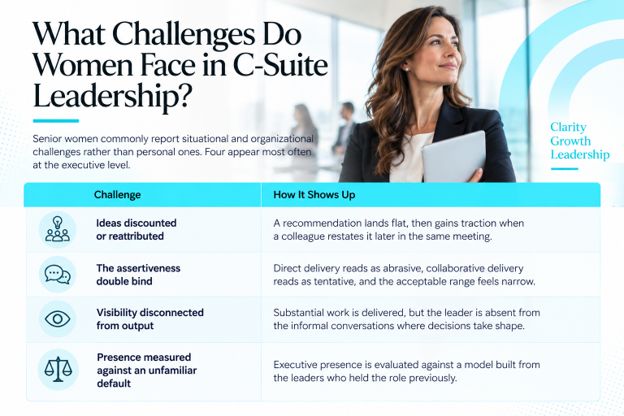
Senior women commonly report situational and organizational challenges rather than personal ones. Four appear most often at the executive level.
| Challenge | How It Shows Up |
| Ideas discounted or reattributed | A recommendation lands flat, then gains traction when a colleague restates it later in the same meeting |
| The assertiveness double bind | Direct delivery reads as abrasive, collaborative delivery reads as tentative, and the acceptable range feels narrow |
| Visibility disconnected from output | Substantial work is delivered, but the leader is absent from the informal conversations where decisions take shape |
| Presence measured against an unfamiliar default | Executive presence is evaluated against a model built from the leaders who held the role previously |
A 2024 meta-analytic review in The Leadership Quarterly, synthesizing 50 years of research on gender and leadership evaluations, found the evidence most consistent with women facing higher barriers to leadership entry and needing to demonstrate exceptional competence to reach and hold senior roles.
Perceived competence appears to moderate what happens next. Feng, Ma, Dwivedi, and Liu, publishing in the Journal of Applied Psychology in February 2026, observed the dominance penalty at lower levels of perceived leader competence but not at higher levels, with the gender difference disappearing where perceived competence was high. That study measured perception, not coaching.
Fettner’s working proposition, drawn from her practice, is that perceived and demonstrated competence are separate things, and the distance between them responds to deliberate work on delivery and visibility.
The distinction has practical value. A leader who reads a stalled recommendation as evidence of her own inadequacy will spend her effort on the wrong problem.
What Changed for a Chief Data Officer in a Global E-Commerce C-Suite
One engagement Fettner has published illustrates the pattern precisely. The client was a Chief Data Officer at a global e-commerce corporation, known internally as a star for her ability to manage and use data to shape business strategy and direction. She was one of only two women in that C-suite.
She had no doubt about her capabilities — she recognized they were unsurpassed at the company.
What she observed was narrower: her ideas were not being listened to as seriously as those of her male counterparts. The gap sat in communications and executive presence rather than in the quality of her analysis.
The engagement worked on four items:
- A customized structured plan to build confidence, calibrated to her actual standing rather than a generic confidence curriculum.
- Techniques for assertive communication, expanding how a recommendation gets delivered and defended.
- An authoritative public speaking style, developed for the presentations where her work reached the executive team.
- A reworked professional image, aligning how she presented with the C-suite executive she already was.
Fettner’s explanation of the outcome is that she commanded the attention she deserved and gained new respect and attention for her input and presentations.
What the engagement did not involve is equally instructive: no change to her expertise, her judgment, or her fundamental approach to leadership.
Reaching the room is a different problem from having something worth saying. A 30-minute fact-finding session with Fettner Executive & Professional Career Coaching identifies which one is actually in play.
What Executive Coaching Can and Cannot Change
Coaching operates on the leader’s behavior and strategy. It does not operate on the organization, which is a boundary worth understanding before an engagement begins.
| Within Reach of Coaching | Outside It |
| How a recommendation is structured, delivered, and defended | Whether the organization has a functioning promotion process |
| Which stakeholders get aligned, and in what order | A board or CEO already committed to a particular successor |
| How the leader is perceived, measured through multi-rater feedback | Compensation structures and pay equity decisions |
| Visibility in the conversations where decisions form | Whether an organization values the leader’s contribution |
The distinction matters for a specific reason. A leader working on communication technique when the actual constraint is an organization that has decided against her is spending effort in the wrong place. Determining which category a difficulty falls into is part of the initial assessment.
What Does an Executive Coach Work On With Female Executives?
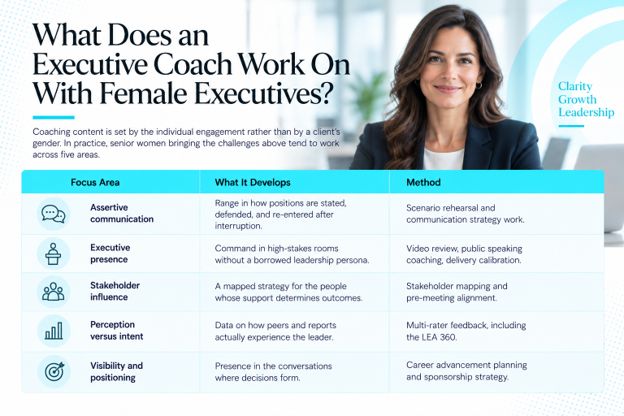
Coaching content is set by the individual engagement rather than by a client’s gender. In practice, senior women bringing the challenges above tend to work across five areas.
| Focus Area | What It Develops | Method |
| Assertive communication | Range in how positions are stated, defended, and re-entered after interruption | Scenario rehearsal and communication strategy work |
| Executive presence | Command in high-stakes rooms without a borrowed leadership persona | Video review, public speaking coaching, delivery calibration |
| Stakeholder influence | A mapped strategy for the people whose support determines outcomes | Stakeholder mapping and pre-meeting alignment |
| Perception versus intent | Data on how peers and reports actually experience the leader | Multi-rater feedback, including the LEA 360 |
| Visibility and positioning | Presence in the conversations where decisions form | Career advancement planning and sponsorship strategy |
Multi-rater data does particular work in the fourth area. The Leadership Effectiveness Analysis 360, developed by Management Research Group, gathers structured feedback on 22 observable leadership behaviors from boss, peers, and direct reports, replacing speculation about reputation with observation.
Marilyn Fettner is a Certified Administrator of the LEA 360 Suite, and the broader range of career, personality, and ability tests she administers establishes a baseline before setting coaching objectives.
How Can Female Executives Build Presence and Communicate Assertively?
Assertive communication develops by expanding range rather than adopting a different personality. The objective is more available registers, so a leader can choose delivery based on the room instead of defaulting to one mode everywhere.
The authenticity concern is legitimate. A borrowed executive persona risks reading as inauthentic, which is why coaching builds on a leader’s existing style rather than replacing it.
Practical range-building looks concrete: reclaiming the floor after an interruption without escalating, stating a recommendation before the supporting analysis, holding a position under challenge without hardening, and declining to soften a conclusion that does not warrant softening.
Coaching treats executive presence as a set of observable behaviors rather than an innate quality, because behaviors are observable and respond to practice.
Those behaviors include how a leader enters a discussion, handles disagreement, and delivers under scrutiny, developed through practiced board-level communication and structured communication and social skills work.
The chief executive’s engagement followed this exact shape: an assertive technique, an authoritative speaking style, and a professional image, all enhanced an existing leadership approach.
Is Executive Coaching Different for Women Leaders, and When Should One Start?
The method is identical. What differs is the situational content a senior woman is more likely to bring, particularly when she is one of a small number of women on an executive team.
Common starting points include a recent C-suite appointment, a pattern of recommendations that stall without clear technical objection, board or investor exposure beyond prior experience, or influence that is not tracking with contribution.
Fettner’s coaching approach favors beginning at an observable gap rather than at a crisis, since the behaviors involved develop through repeated practice and a compressed timeline limits what an engagement can realistically address in a timely manner.
One Fettner client described the political landscape of a new senior role as overwhelming and credibility difficult to establish, and reported afterward that coaching rebuilt her confidence and left her feeling validated as a member of the C-suite.
Marilyn Fettner’s training as a Licensed Clinical Professional Counselor informs how she approaches the interpersonal and perceptual dimensions of executive coaching, which is professional development work rather than clinical treatment.
Frequently Asked Questions
How can executive coaching help women succeed in the C-suite?
Executive coaching builds influence, executive presence, assertive communication, and stakeholder strategy calibrated to a leader’s specific organization. The work expands the delivery tools available to an accomplished executive rather than addressing capability, which is rarely the constraint at this level.
What challenges do women face in C-suite leadership?
Commonly reported challenges include recommendations discounted or reattributed, a narrow acceptable range between assertive and collaborative delivery, visibility disconnected from output, and presence measured against a default model built from previous holders of the role.
What does an executive coach help female leaders with?
Common focus areas include assertive communication, executive presence, public speaking, professional image, stakeholder influence mapping, and multi-rater feedback showing how peers actually experience the leader. Content is set by customized individual engagement rather than one standard approach applied to all individuals.
How can women develop stronger executive presence?
Coaching treats presence as observable behavior rather than an innate quality: how a leader enters a discussion, handles disagreement, and delivers under scrutiny. Video review, rehearsed board-level delivery, and structured feedback build those behaviors without requiring a borrowed persona.
How can female executives communicate more assertively?
Assertive communication develops by expanding range rather than changing style. Practical skills include reclaiming the floor after interruption without escalating, stating recommendations before supporting analysis, and holding a position under challenge without hardening the delivery.
How can women increase their influence with senior stakeholders?
Influence increases through mapping which stakeholders determine outcomes, understanding what each is accountable for, and building alignment before the decision meeting. Coaching develops this as a repeatable strategy rather than a series of individual conversations.
Is executive coaching different for women leaders?
The method is the same. Situational content often differs, particularly for executives who are one of the few women on a leadership team and are working on visibility, perception, and influence with limited peer comparison available to them.
When should a female executive consider working with an executive coach?
Common triggers include a recent C-suite appointment, preparation for being recognized as C-suite material, recommendations that stall without clear technical objection, board exposure beyond prior experience, or influence not tracking with contribution. Fettner’s approach favors starting at an observable gap rather than at a crisis.
Can coaching fix an organization that undervalues a leader?
No. Coaching works on a leader’s behavior and strategy, not on promotion processes, succession decisions, or pay structures. Distinguishing a communication constraint from an organizational one is part of the initial assessment, because the two require different responses.
The Bottom Line
Executive coaching for women in the C-suite addresses situational challenges rather than personal deficits.
Women hold 29% of C-suite roles, and leaders in a small minority face different room dynamics regardless of capability. Recent research indicates the penalty for assertive behavior weakens as perceived competence rises.
Fettner’s engagement with a Chief Data Officer focused on confidence, assertive communication, public speaking, and professional image, and her input subsequently drew greater attention. Her expertise never changed.
Accomplished leadership deserves to land with the weight it has earned. Fettner Executive & Professional Career Coaching builds that capability — book a consultation with Marilyn Fettner.