

How Executive Career Coaching Accelerates the First 90 Days for New VPs
The first 90 days in a new VP role set the slope of your entire tenure—high pressure, limited margin for error, and outsized visibility.
Many new VPs find themselves tangled in complex stakeholder webs, trying to earn their teams’ trust and juggling strategic priorities while keeping operations afloat.
Executive career coaching adds structure, accountability, and just-in-time decision support. Analysts frequently cite high failure rates for senior transitions (often estimated at ~40–50%); coaching improves the odds by accelerating learning, alignment, and early wins.
Unlike checklist onboarding, coaching adapts to the VP’s context—culture, stakeholders, scope, and the decisions that matter this quarter.
What separates VPs who soar from those who stall is how they **sequence** relationships, wins, and decisions in the first 90 days.
Coaching enforces that sequence. Executive coaching for first-time VPs helps leaders make a strong first impression and lay the groundwork for future wins.
With the right coach, new VPs can build credibility, get everyone on the same page, and start creating momentum that might even set them up for a promotion before their first anniversary.
Key Takeaways
- Executive coaching slashes the high failure rate for new VPs by providing structured frameworks and tailored guidance during the crucial first 90 days.
- Coached VPs build better relationships and earn credibility faster than those who try to go it alone.
- Systematic coaching with real metrics and accountability speeds up early wins and puts VPs on track for long-term leadership success.
What Changes When A VP Has A Coach In The First 90 Days

With coaching support, a VP gets weekly accountability and clear milestone tracking. They don’t just react—they spot cultural or operational risks and start building evidence of early wins right away.
Micro-Cadence: Weekly Sessions Plus Shadow Notes
Executive coaching sets up regular progress checks through weekly meetings rather than the drawn-out monthly reviews.
Each session zooms in on immediate problems and tough decisions. The coach jots down shadow notes during key meetings and stakeholder chats.
Weekly sessions usually include:
- Checking progress against 30/60/90-day goals
- Spotting roadblocks and brainstorming fixes
- Updating stakeholder maps
- Tweaking decision-making frameworks
Shadow notes reveal patterns and blind spots the VP might overlook. The coach observes team dynamics and gives direct feedback on leadership style.
This rhythm helps VPs nip small issues in the bud. They can pivot quickly, rather than letting problems snowball unnoticed.
Early Wins: Define And Socialize Day-45 Proof Points
Coached VPs to pick clear, measurable wins to show value by day 45. They don’t just hope people notice—they actively share these achievements with key stakeholders.
The coach helps pinpoint which early wins will matter most to the organization. They aim for outcomes that align with the company’s priorities and the VP’s goals.
Typical 45-day proof points:
- Process tweaks with real results
- Bumps in team productivity or efficiency
- Wrapping up inherited projects
- Kicking off new strategic initiatives
The coach also teaches VPs how to promote these wins without coming off as braggy. It’s a tricky balance, honestly.
Initial coaching alignment ensures these wins support the company’s bigger goals. That momentum builds credibility with senior leadership.
Risk Sweeps: Anticipate Traps In Culture, Scope, And Span Of Control
Executive coaches run systematic risk checks in three key areas during the first 90 days. This strategy helps VPs dodge common transition pitfalls.
Cultural traps can trip up even the sharpest leaders. Coaches help decode unspoken rules and guide VPs to adjust their approach.
Scope creep sneaks in when VPs bite off more than their job description. Coaches keep them focused on what matters and help build the right partnerships.
Span of control issues arise when VPs struggle to manage their direct reports. The coach shares frameworks for delegation and team building.
First-time executives really need this to avoid career-limiting blunders. Regular risk sweeps catch problems before they get out of hand.
The coach uses structured tools to check each risk area every week. They help VPs craft backup plans and strategies to sidestep trouble.
The First-90-Days Framework (And Why VPs Stall Without Coaching)
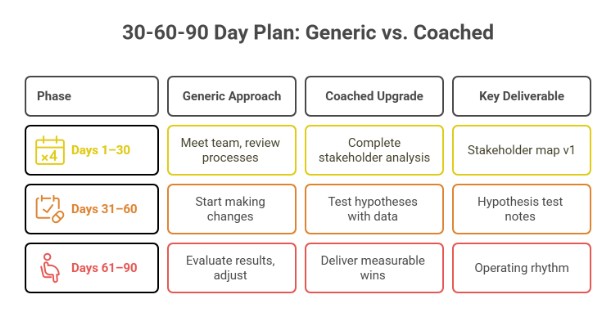
Executive coaching turns generic onboarding into a focused acceleration plan that helps VPs avoid the usual traps.
The Core Playbook (Watkins): Diagnose, Align, Secure Early Wins
The Transition Roadmap covers eight core tasks to help leaders position themselves effectively. New VPs start by diagnosing their organizational context with targeted assessment tools.
The STAR model breaks down organizations into five types: Startup, Turnaround, Accelerated Growth, Realignment, and Sustaining Success. Each one calls for a different leadership style and approach to early wins.
Some diagnostic questions:
- What business headaches need fixing now?
- Which relationships will make or break your success?
- What cultural quirks could help or trip you up?
Once they are diagnosed, VPs align with key stakeholders through structured talks about priorities, metrics, and resources. Early wins need to tie directly to business outcomes and help the VP earn trust across the board.
Why VPs Derail: Misread Context, Mis-Sequenced Wins, Stakeholder Blind Spots
Most VP flameouts come from three big mistakes. First, they misread the context—trying to use old playbooks in a brand-new setting.
For example, if a VP comes from a startup and moves to a big, established company, they might push for quick changes. But the new culture values process and stability, so they hit a wall. Without a coach, they just push harder instead of adjusting.
Classic mis-sequencing mistakes:
- Rolling out changes before building buy-in
- Chasing quick wins without laying a strategic foundation
- Restructuring before really understanding the current setup
Stakeholder blind spots are even riskier. New VPs often focus just on their direct reports and bosses. They overlook peers, customers, or board members who can seriously influence their success—or derail it.
These folks often wield informal power, shaping everything from resource allocation to decision speed. Missing these relationships can cause nasty surprises during big rollouts.
Government-Grade Onboarding Aims By Day 90 (Competence Plus Forums)
High-stakes organizations go way beyond basic orientation. They use structured, competency-based onboarding to measure leadership chops in detail.
By day 90, VPs should hit these targets:
- Strategic Assessment: Complete a real diagnosis and set action priorities
- Stakeholder Mapping: Build active relationships with 15+ key players
- Team Calibration: Assess direct reports and set up development plans
- Cultural Integration: Understand how decisions get made and how people really communicate
Forums give ongoing support through peer groups and mentors. Executive coaching programs blend one-on-one coaching with group learning.
These programs track progress by real milestones, not just time. VPs prove themselves with business results and feedback, not just by clocking in 90 days.
Table — 30-60-90 At A Glance (Generic Vs. Coached)
| Phase | Generic Approach | Coached Upgrade | Key Deliverable |
| Days 1–30 | Meet team, review processes, and attend standard meetings | Complete stakeholder analysis; run structured listening tours; form 3 strategic hypotheses | Stakeholder map v1; Day-30 clarity memo |
| Days 31–60 | Start making changes; implement quick fixes; focus on direct reports | Test hypotheses with data; build a coalition for priority initiatives; establish feedback loops | Hypothesis test notes; Early-win brief |
| Days 61–90 | Evaluate results; adjust; plan next quarter | Deliver measurable wins tied to business outcomes; launch sustainable operating mechanisms | Operating rhythm; Next-90 roadmap |
The coached approach pushes for validation before action and relationship-building before shaking things up. That helps VPs avoid the trap of early wins followed by mid-term stalls—a surprisingly common pitfall.
What The Coach Actually Does To Accelerate Your Ramp
The coach maps out a systematic first-90-days plan using five core frameworks. Each one tackles a specific challenge that can trip up new VPs.
Learning Agenda And Listening Tour Design
The coach doesn’t just tell you to “meet people.” They help you craft a real learning plan, not just a string of awkward coffee chats. You’ll get specific questions for each group and a way to track what you hear.
Key Questions Framework:
- Business context: What’s our market position? Who’s the competition? Where are the roadblocks?
- Team dynamics: Who’s crushing it? Where are the gaps? Any cultural friction?
- Process issues: Where do decisions stall? Where does communication break down? Are we short on resources?
The coach helps you plan 15-20 strategic conversations across different levels and functions. It’s a real listening tour, not just a box to check.
This way, you avoid those vague chats that go nowhere. Every interaction deepens your understanding and builds relationships.
Stakeholder Map: Allies, Skeptics, Kingmakers; Influence Plan
Executive career coaches help high-level professionals navigate tricky organizational dynamics. They build a detailed map of key players and the drivers that motivate them.
Stakeholder Categories:
- Allies: Back your success by offering resources and info.
- Skeptics: Challenge your decisions, want proof you can deliver.
- Kingmakers: Hold the keys to resources and steer big decisions.
The coach creates influence strategies tailored to each group. For skeptics, they focus on proof points and small wins to build trust. With kingmakers, they look for shared goals and clear value.
Mapping out stakeholders helps new executives avoid political landmines. Coaches update this analysis as relationships shift during the transition.
Decision Journal: Faster, Higher-Quality Calls Under Uncertainty
New VPs feel the heat to decide fast, even when the facts are fuzzy. Coaches set up a decision journal system to boost both speed and quality.
The journal tracks assumptions, data, and the reasoning behind each big call. Over time, this creates a feedback loop that sharpens judgment.
Decision Framework:
- What info’s missing, and can you get it quickly?
- What happens if you wait versus act now?
- Who needs to weigh in, and who just needs to know?
Coaches check in weekly to spot patterns and blind spots. This habit helps VPs get better at making tough calls under pressure.
The journal also gives you a paper trail for explaining decisions when stakeholders want answers.
Communication Rhythm: Narratives For Team, Peers, Board
Coaches help set up different rhythms and messages for each group. Team updates highlight vision, priorities, and support. Peer messages focus on working together and sharing resources.
With the board, it’s all about progress metrics and risk. Coaches help shape stories that build trust—without promising the moon.
Communication Calendar:
- Weekly team updates: priorities and roadblocks.
- Monthly peer briefings: cross-functional projects.
- Quarterly board reports: metrics and strategy.
Coaches keep messages consistent while tweaking content for each group. That way, leaders avoid sending mixed signals that could shake confidence.
Early-Win Architecture: Choose Wins That Compound, Not Distract
Coaches guide VPs to pick early wins that actually matter for long-term goals. They steer leaders away from flashy, quick fixes that don’t last.
Win Selection Criteria:
- Show off core skills needed for future success.
- Strengthen ties with key stakeholders.
- Lay groundwork for bigger projects.
Coaches help early wins tell a story about the VP’s approach. Each win should tee up the next big move.
They also sequence wins to maintain momentum. It’s easy to burn through all the easy stuff early, then hit a wall—coaches help avoid that.
ROI And Outcomes You Can Expect By Day 90

Executive coaching delivers measurable returns within the first 90 days. Studies show ROI in the hundreds of percent. New VPs can track behavioral changes and performance metrics beyond the financials.
Metrix Global Result Often Cited: ~788% ROI Context and Limits.
The 788% ROI figure from Metrix Global pops up a lot in coaching circles. They included gains in productivity and boosts in employee retention.
The study measured hard results like revenue and cost savings, but also soft stuff—lower turnover, faster decisions.
Key limitations exist with this data. The study looked at seasoned execs, not brand-new VPs. Results varied widely by industry and company size.
They counted indirect benefits that may take longer than 90 days to show up. So, new VPs should probably expect more modest gains at first while they build up steam.
ICF Summaries: High ROI Agreement Across Orgs
International Coach Federation numbers show strong returns across all sorts of companies. Most see an ROI of 300-500% within 6 months of coaching.
Executive coaching ROI studies point to a few big drivers: faster ramp-up, better team performance, and fewer hiring mistakes.
Financial firms see the most significant early gains. Tech companies see big jumps in leadership effectiveness. Manufacturing outfits often see smoother operations.
The pattern holds across sectors so that new VPs can expect a similar arc, no matter their industry.
Evidence Caveats: Beyond ROI—Behavioral & Cultural Outcomes
Financial ROI is just one piece of the coaching puzzle for new VPs. Behavioral and cultural shifts often make the biggest difference in the long term.
Confidence-building usually kicks in during the first month. VPs say they feel more ready for tough conversations and strategic choices. This new confidence shows up in how they lead teams.
Relationship quality jumps by day 60. Direct reports give higher engagement scores when their VP has coaching support. Cross-functional partnerships also start to click faster.
Cultural integration speeds up with a coach in the mix. New VPs learn the unspoken rules and handle politics better. That means fewer costly mistakes that can wreck early credibility.
These outcomes are tricky to measure but ultimately drive lasting success.
Table — Outcome Benchmarks To Track
| Outcome Metric | Target by Day 30 | Target by Day 60 | Target by Day 90 |
| Weekly Team Pulse (2-question) | ≥ +10% vs. baseline | ≥ +20% | ≥ +35% |
| Direct Report 1:1 Quality | 6/10 average | 7/10 average | 8/10 average |
| Strategic Initiative Progress | 25% complete | 60% complete | 90% complete |
| Stakeholder Relationship Rating | 3/5 average | 4/5 average | 4.5/5 average |
| Decision Latency (days) | ↓ 15% vs. baseline | ↓ 30% | ↓ 45% |
| Cross-Functional Projects Done | 1 completed | 2 completed | 3+ completed |
Track these benchmarks weekly during coaching. Adjust for your company’s quirks and the role’s complexity.
Soft metrics matter just as much. Keep an eye on stress, work-life balance, and confidence. Those are solid predictors of long-term success and whether VPs stick around.
The 12-Week Coaching Cadence For A New VP (Practical Plan)
A structured 12-week coaching program gives new VPs clear checkpoints and ways to measure progress. The cadence starts with heavy support and eases off as leaders get their footing.
Week-By-Week Sequence (Kickoff, Listening Tour, Early-Win Sprint, Reset)
Weeks 1-2: Strategic Kickoff
The coaching relationship starts with goal-setting and stakeholder mapping. VPs pick their top three priorities and plan a listening tour. Coaching sessions build confidence for those first one-on-ones with direct reports and key players.
Weeks 3-6: Active Listening Tour
Coaches guide VPs through stakeholder interviews and team assessments. Each session includes a debrief on what stood out and how to use the feedback. Coaches help spot patterns and early red flags.
Weeks 7-9: Early-Win Sprint
The focus shifts to scoring some quick wins that boost credibility. Coaches help VPs pick projects that show value right away and set the stage for bigger changes. Sessions dig into decision-making and communication tactics.
Weeks 10-12: Strategic Reset
This phase is about reflecting and planning for what’s next. VPs review their first 90 days, identify key lessons, and outline plans for ongoing growth. Coaches help lock in accountability systems for the future.
Shadow Work: Coach Reviews Decks, Emails, And Talk Tracks Between Sessions
Great coaching doesn’t stop at scheduled meetings. Coaches review decks before big presentations, helping VPs tighten their message and prep for tough questions.
Email becomes a coaching tool, too. Coaches review drafts to ensure the tone and message align with the VP’s leadership style. This includes tricky emails about team changes or shifts in strategy.
Coaches pay special attention to talk tracks for tough conversations. They help VPs practice giving feedback to struggling team members or sharing hard news with senior leaders. This prep reduces nerves and improves outcomes.
Shadow work means VPs get feedback on real work, not just hypotheticals. It’s a chance to learn in the flow of actual job demands.
Escalation Protocols For “Oh-No” Moments
New VPs sometimes face crises that can’t wait. Good coaching programs set up clear protocols for urgent support.
Emergency Session Triggers include major team blowups, sudden departures, or major leadership pivots. Coaches make themselves available within 24 hours for these emergencies.
Rapid Response Format means 30-minute calls focused on quick action. Coaches help VPs size up the mess and figure out the next move.
Follow-Up Requirements keep things from falling through the cracks. Coaches schedule check-ins within 48-72 hours to see how things landed and tweak the plan if needed.
Table — 12-Week Cadence
| Week | Focus | Key Activities | Accountability Metric |
| 1–2 | Strategic Kickoff | Stakeholder mapping; priority setting; success criteria | 3 strategic goals defined |
| 3–4 | Listening Tour Launch | Direct report 1:1s; peer intros; customer/partner discovery | ≥ 10 stakeholder interviews |
| 5–6 | Feedback Synthesis | Pattern ID, team assessment, hypothesis formation | Complete team evaluation |
| 7–8 | Early-Win Execution | Launch 1–2 visible improvements; socialize proof points | ≥ 2 visible improvements |
| 9 | Mid-Point Assessment | Progress review; course correction; risk sweep | Updated action plan |
| 10–11 | Strategic Implementation | Stand-up operating mechanisms; initiative charters; delegation plans | Key projects launched |
| 12 | Reflection & Planning | 90-day review; Next-90 roadmap; metrics lock | 90-day success assessment |
Struggling to prioritize wins or handle pressure from every direction? A focused session with Fettner Executive & Professional Career Coaching turns chaos into clarity and momentum. Take control—Schedule an appointment.
Stakeholder Strategy: Who To Align And How
New VPs really need to map both internal and external stakeholders during those first 90 days.
The trick is figuring out who makes decisions, who influences them, and who connects the dots across the org—then having real, structured conversations that actually build trust and alignment.
Internal Map (CEO, CFO, People Ops, Peer VPs, Key ICs)
C-suite alignment sets scope, resources, and decision style—establish weekly touchpoints for the first month.
New VPs should book weekly check-ins for at least the first month. That’s how you pick up on decision-making styles and get a feel for how they want to communicate.
The CFO holds the purse strings and owns the reporting structure. If you’re a new VP, you’ve got to get a handle on quarterly planning and how budgets get negotiated, and you need to do it early.
Peer VP Relationships can get tricky. These lateral partnerships make or break cross-functional projects. Stakeholder-centered coaching holds that peer relationships are non-negotiable for real results.
People Ops gives you the inside scoop on team dynamics, reviews, and company culture. They’re also the ones helping with hiring and any team shake-ups.
Key Individual Contributors are where the rubber meets the road. Spot your top performers and anyone who might be thinking of leaving—ideally within your first month. These folks keep the day-to-day running smoothly.
External/Lateral Map (Customers, Partners, Board Observers)
Customer stakeholders aren’t just buyers—sometimes they’re internal teams, too. New VPs need to dig into customer satisfaction, renewal rates, and the causes of escalations. That’s how you know where to put your team’s energy.
Strategic partners shape your product and go-to-market playbook. Map out those agreements, integration deadlines, and what “success” looks like together, preferably right away.
Board observers and advisors bring industry perspective and strategic oversight. They don’t report to you, but their opinions can steer executive decisions and even company direction.
Executive coaching for career transitions provides leaders with a systematic approach to identifying and engaging external players. It’s no wonder it helps reduce the crazy-high failure rate among new execs.
Scripts & Sequences: 15-Minute Value Exchange Meetings
Open with a simple **value-exchange frame**: “I want to understand your priorities and where my team can create leverage fast.”
The Discovery Phase is all about three questions:
- What are your top three priorities this quarter?
- What’s slowing you down right now?
- How can my team help you hit your goals?
Value Proposition comes next. Share what your team’s good at and what wins you’ve had that matter to them. Don’t oversell—just connect the dots.
Negotiation elements usually pop up naturally. People will ask for resources, deadline tweaks, or even a shift in priorities. VPs have to weigh those asks against what the team can actually pull off and what matters most.
Follow-up commitment wraps things up. Summarize what you heard, agree on next steps, and schedule the next meeting. That’s how you show you’re reliable and keep things moving.
Repeat this approach with everyone—internal, external, you name it. It’s the backbone of your first 90 days.
Metrics That Matter In The First 90 Days
Track a small set of leading indicators now (trust, decision latency, proof points); scale dashboards only after credibility is established.
Leading Indicators By Function (Examples And Targets)
Sales VPs should monitor pipeline velocity and the team’s adoption rate of new processes. One great sign: landing 3-5 key customer meetings in the first month. Sales teams usually get behind leaders who show they care about customers right away.
Marketing VPs should track how fast campaigns launch and how often they collaborate with other teams.
Executive coaching helps new leaders find the right metrics for their job. Meeting with 10-15 stakeholders in 45 days is a solid sign you’re building the right relationships, too—see why that matters.
Operations VPs should measure how quickly they spot and launch process improvements.
Finding 2-3 quick wins that save time or money shows you’re adding value. Weekly team feedback scores can also give you a pulse check on your leadership—early signals matter.
Target Framework:
- Days 1-30: Relationship metrics (meetings held, feedback collected)
- Days 31-60: Process metrics (improvements identified, quick wins launched)
- Days 61-90: Impact metrics (early results from changes implemented)
Lagging Indicators You Should Not Over-Weight Before Day 90
Revenue growth and market share take a while to reflect new leadership. These numbers usually depend on decisions made before you even showed up, plus market stuff you can’t control.
Employee engagement scores from yearly surveys just don’t capture the ups and downs of a leadership change. Metrics showing coaching works often take half a year or more to show up for real.
Customer satisfaction ratings lag what’s actually happening on the ground. If new VPs obsess over these too soon, they might miss the more important early signals from direct relationships.
Avoid Over-Weighting:
- Quarterly revenue numbers
- Annual engagement surveys
- Long-term customer retention rates
- Market position rankings
Instrumentation & Dashboards (Lightweight Now, Robust Later)
Simple spreadsheets usually beat complex systems during those first 90 days. New VPs need fast visibility into key relationships and early wins, not deep analytics right away.
Track just 5-7 core metrics. Include topics such as stakeholder meeting frequency, team feedback themes, and quick-win progress.
Update these weekly, not daily. Nobody wants analysis paralysis in their first few months.
Week 1-4 Dashboard:
- Stakeholder meetings completed
- Key challenges identified
- Team member 1:1s held
Week 5-12 Dashboard:
- Quick wins launched
- Process improvements identified
- Cross-functional relationships established
Build robust systems only after you’ve got some credibility and a real sense of what the organization needs. Creating detailed action plans actually works better once you’ve formed those initial relationships.
Table — KPI Flywheel
| Timeframe | Leading Indicator (Target) | Trigger | Leadership Impact |
| Days 1–30 | Stakeholder meetings (≥ 15) | Schedule follow-ups, align asks | Trust foundation set |
| Days 31–60 | Quick wins identified (3–5) | Launch improvement initiatives | Demonstrates competence |
| Days 61–90 | Team pulse ≥ 7/10; decision latency ↓ | Adjust leadership approach | Credibility established |
| Days 91+ | Processes live (2–3) | Scale what’s working | Sustainable results |
Each metric sets up the next phase. Strong stakeholder relationships make it easier to spot quick wins.
Those early wins build team confidence, which leads to better feedback and longer-term improvements.
Day-45 Proof-Point Ideas
| Function | Proof-Point (example) | Metric |
| Sales | Pipeline hygiene blitz with stage definitions | % opps updated; forecast variance ↓ |
| Product | PRFAQ review to kill/accelerate two bets | Bets reallocated; cycle time ↓ |
| Ops | SLA triage fixing two bottlenecks | SLA adherence ↑; ticket aging ↓ |
| Finance | Reduce the month-end close time | Close time ↓; error rate ↓ |
Common Traps (And The Coach’s Counter-Moves)
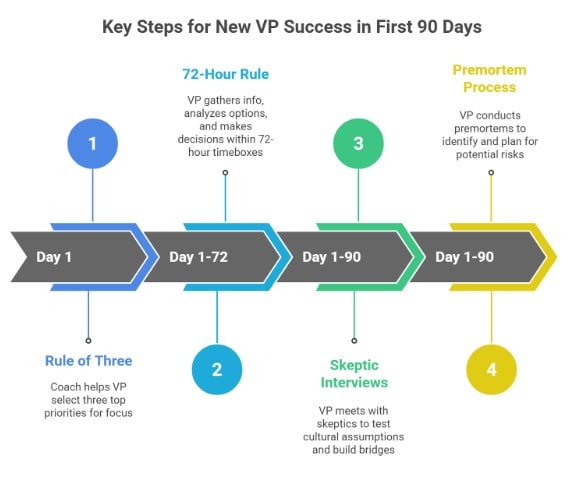
The most common early failures are predictable; counter them with ruthless sequencing, skeptic interviews, timeboxed decisions, and premortems.
Executive coaching actually works best when it helps leaders spot and break old patterns, not just pile on new skills.
Too Many Priorities – Ruthless Sequencing
Getting promoted to VP brings a tidal wave of demands. Most new execs try to handle everything, thinking it’ll prove they can do the job.
But trying to do it all just scatters your energy. Nothing gets the focus it needs for real progress.
The Coach’s Counter-Move: The Rule of Three
Good coaches push their clients to pick exactly three priorities for those first 90 days. Not four, not two—three.
Here’s the usual framework:
- Priority 1: The must-win battle that defines early success
- Priority 2: The relationship-building initiative that creates allies
- Priority 3: The quick operational fix that shows competence
Everything else goes in a “later” bucket. It’s tough, but that’s how you get momentum.
The coach helps the VP explain these priorities clearly to their team. This move builds their executive brand as someone who can cut through the noise.
Culture Clash – Narrative Testing With Skeptics
New VPs often misread the company culture. They try old approaches that worked elsewhere, not realizing the local dynamics are different.
Common executive career transition mistakes include assuming that what worked before will work again, automatically.
The Coach’s Counter-Move: Skeptic Interviews
Coaches usually guide VPs to identify the organization’s biggest skeptics. These are the folks who aren’t sure about the new leader’s approach.
The VP sits down with these skeptics for informal chats. Not to win them over right away, but to test assumptions about what works here.
Some key questions:
- “What approaches have failed here before?”
- “What would surprise you in a good way?”
- “Who do people here really respect and why?”
This process uncovers hidden cultural landmines. It also starts building bridges with critics before problems blow up.
Analysis Spiral – Decision Timeboxes And Defaults
Many new VPs get stuck collecting endless information. They want perfect data before making choices, and that just leads to decision paralysis.
Teams lose faith when leaders can’t decide. Opportunities slip away while the VP runs another analysis.
The Coach’s Counter-Move: The 72-Hour Rule
Coaches push VPs to timebox their decision-making. For most choices, 72 hours is enough to gather the essentials.
The system looks like this:
- Hour 0-24: Rapid info gathering from key stakeholders
- Hour 24-48: Analyze and develop options
- Hour 48-72: Final input and then make the call
Coaches also help set default decisions. If the info isn’t perfect by the deadline, what’s the safest choice that keeps things moving?
This approach builds a reputation for decisiveness. It also forces the VP to trust their gut, which honestly matters more than people admit.
Early-Win Backfires – Risk Premortems
New VPs often chase quick wins without thinking through the risks. They want to impress right away.
But rushed moves can sour relationships or create new headaches. Today’s win can turn into tomorrow’s crisis.
The Coach’s Counter-Move: The Premortem Process
Before any big early move, coaches run premortems with their clients. They imagine the initiative crashed and burned six months later.
That exercise helps spot where things could go wrong:
- Political risks: Who might resist and why?
- Resource risks: What hidden costs could pop up?
- Timeline risks: What dependencies could cause delays?
- Reputation risks: How might failure affect the VP’s standing?
This process doesn’t kill good ideas. It just makes them tougher by surfacing issues before they happen.
The VP goes in with backup plans already in hand. That prep actually builds more confidence than just moving fast for the sake of it.
Selecting The Right Executive Coach For A New VP
Prioritize transition expertise, a structured discovery, tangible artifacts, and measurable checkpoints over generic leadership coaching.
Look for credentials specific to leadership transitions, ask about their discovery process, and set clear engagement terms from the start.
Credentials & Experience To Look For
New VPs need coaches who focus on executive transitions and leadership development. Certifications from the International Coach Federation (ICF) or the Center for Executive Coaching are a good sign.
But honestly, experience matters even more than credentials. Look for coaches who’ve worked with execs during role transitions and understand the grind of managing former peers and building credibility fast.
Key qualifications include:
- 5+ years coaching C-suite or VP-level executives
- Background in organizational psychology or business leadership
- Track record with transition coaching specifically
- Industry knowledge relevant to the VP’s sector
Ask for case studies of similar transitions. The coach should show they get the politics, stakeholder management, and pressure for quick wins.
What A Great Discovery Call Sounds Like
The coach-client relationship actually determines coaching success. A good discovery call gives you a taste of the coach’s style and approach.
The coach should ask real questions about your transition challenges. Expect them to dig into team dynamics, immediate priorities, and how you’ll define success in those first 90 days.
Red flags during discovery calls:
- Generic questions that could fit any exec
- Jumping into a sales pitch without asking about your needs
- No structure or clear method
- No talk of measurable outcomes
Great coaches listen more than they talk. They’ll show curiosity about your specific situation and toss out early insights that show they get it.
The coach should walk you through their methodology. Maybe they’ll mention frameworks for stakeholder mapping or for quickly assessing teams.
Engagement Model: Scope, Session Length, Artifacts, Confidentiality
Coaching engagement structure really shapes the results. Nail down the scope, frequency, and deliverables before you start.
Most effective VP transition coaching runs 3-6 months. Weekly 60-90 minute sessions are usually enough during those critical early weeks.
Essential engagement elements:
- Scope: Focus on first 90-day priorities and stakeholder relationships
- Sessions: Weekly for the first month, then bi-weekly
- Artifacts: 90-day plan, stakeholder maps, progress dashboards
- Confidentiality: Clear boundaries on what gets shared with the company
The coach should offer tools and frameworks between sessions. You might get assessment templates, communication guides, or decision frameworks.
Set measurement criteria up front. Track progress with 360 feedback, stakeholder interviews, or hitting your goals.
Table — Coach Selection Checklist
| Evaluation Criteria | Required | Nice-to-Have | Red Flag |
| Credentials | ICF (or equivalent) + 5+ yrs VP coaching | Industry-specific experience | No formal training |
| Transition Experience | 20+ executive transitions | C-suite coaching background | Only general leadership |
| Discovery Process | Structured assessment; specific questions | 360 review capability | Generic, unstructured |
| Methodology | Clear frameworks; measurable outcomes | Digital tools/platforms | Vague/undefined process |
| Availability | Weekly sessions for ~90 days | Extended availability | Limited scheduling |
| References | 3+ similar VP transitions | Current client testimonials | Reluctant to provide |
| Chemistry | Strong rapport; compatible style | Shared industry background | Poor communication fit |
Sample 30-60-90 Plan (Coached Version You Can Steal)
A coached 30-60-90 converts intentions into artifacts—clarity memo (30), early-win brief (60), operating rhythm + next-90 roadmap (90).
Each phase builds trust and helps you gather the intel you’ll need for smart decisions later.
30 Days: Listening Tour, Trust, Day-30 Clarity Memo
The first month is all about building relationships and understanding how things actually work. New VPs jump in and set up one-on-one meetings with every direct report, key stakeholder, and cross-functional partner they can find.
Key listening tour questions include:
- What’s working well in the current operation?
- What obstacles prevent peak performance?
- What would success look like in 12 months?
During these conversations, the executive takes notes and holds off on making changes. They focus on showing respect for existing knowledge and relationships, and that goes a long way toward building trust.
By day 30, they write up a clarity memo for their manager. This memo summarizes what they’ve noticed, highlights early opportunities, and outlines initial thoughts on the organization’s strengths and gaps.
60 Days: Early-Win Delivery And Org/Portfolio Diagnosis
Month two is when things start moving. The executive picks one quick win—something small that doesn’t require many resources but still makes a splash.
They could streamline a recurring meeting, fix a process that’s been bugging everyone, or make team communication less painful. These wins help prove they’ve got the chops and get everyone fired up.
At the same time, they dive into a thorough organizational and portfolio diagnosis. They look at team capabilities, where resources go, and whether everything aligns with strategy.
The diagnosis covers:
- Team performance and skill gaps
- Process inefficiencies and bottlenecks
- Technology and resource constraints
- Market positioning and competitive threats
Once they’ve got the facts, the executive brings their findings to leadership and shares recommendations backed by data.
90 Days: Operating Rhythm Plus Metrics Locked, Next-90 Roadmap
The last month has been about setting up leadership routines and planning. The executive establishes regular operating rhythms—think team meetings, performance reviews, and stakeholder updates.
They identify key performance indicators that actually align with company goals. These metrics form the backbone for ongoing performance management and smarter decisions.
At the 90-day mark, they roll out a detailed roadmap for the next quarter. It lays out strategic priorities, the resources needed, and the metrics that will signal progress.
The roadmap includes:
- Three strategic initiatives with clear owners
- Budget and resource allocation plans
- Risk mitigation strategies
- Team development priorities
This 90-day plan approach gives the executive a chance to show they can think beyond the daily grind and deliver real, long-term wins.
Table — Coached 30-60-90 (Deliverables)
| Phase | Primary Focus | Key Deliverable | Success Metric |
| 30 Days | Listening & Learning | Clarity Memo to Manager | 100% stakeholder 1:1s; clarity memo accepted |
| 60 Days | Analysis & Quick Wins | Organizational Diagnosis Report | ≥ 1 visible improvement shipped; diagnosis reviewed |
| 90 Days | Systems & Strategy | Next-90 Roadmap + Op Rhythm | Operating rhythm live; roadmap approved |
Your first 90 days shouldn’t feel like survival mode. Transform your transition with leadership coaching from Fettner Executive & Professional Career Coaching, designed for real VP challenges. Lead with confidence—Contact us today.
Frequently Asked Questions
What does executive career coaching actually do in a VP’s first 90 days?
It compresses ramp time by installing a weekly operating rhythm, a contextual 30-60-90 plan, and targeted stakeholder meetings that turn early insights into measurable wins.
Is executive coaching worth it for a new VP’s first 90 days?
Yes—studies and industry surveys frequently report strong ROI from structured coaching; the clearest Day-90 signals are faster alignment, early proof-points, and reduced decision latency.
What should be in a VP’s 30-60-90-day plan?
Include clear objectives, stakeholder introductions, cultural immersion, feedback loops, and phase-specific deliverables (e.g., Day-30 clarity memo, Day-60 early-win brief, Day-90 operating rhythm).
Why do many new executives fail, and how does coaching mitigate that risk?
Common failure drivers include misread context, weak stakeholder alignment, and mis-sequenced early wins; coaching counters with diagnosis, coalition-building, and paced execution to avoid the first-year stall. Frequently cited estimates put executive transition failure near ~40% within 18 months.
Which early metrics should a new VP track in the first 90 days?
Track leading indicators: number/quality of stakeholder meetings, early-win delivery, team pulse, and decision speed—then scale to lagging business metrics after credibility is established.
How soon should a new VP start coaching?
Start before Day 1 if possible (planning and stakeholder mapping), or in Week 1 at the latest, so the listening tour and early-win selection are sequenced correctly.
How does stakeholder mapping accelerate first-90-day results?
A simple influence/interest map pinpoints allies, skeptics, and kingmakers so your 1:1s, messaging, and proof-points land with the people who unlock resources and speed.