

How Do You Know If You’re Ready for the C-Suite? 7 Signs You’re Prepared for Executive Leadership
C-suite readiness shows up most reliably as observable behavior rather than tenure or job title. Seven behaviors are worth examining: enterprise-level thinking, influence without authority, decision-making before the picture is complete, developmental delegation, executive communication, political awareness, and steady direction in ambiguity.
Each appears in a leader’s current role, which means each can be examined before a promotion is on the table.
Structured executive coaching tests those behaviors against observer feedback rather than self-rating alone.
Key Takeaways
- C-suite readiness is behavioral rather than chronological — all seven behaviors ideally appear in a leader’s current role before any title change.
- McKinsey reports that one-third to one-half of new CEOs are considered to be failing within 18 months of taking the role.
- Published assessment instruments measure leadership style, interpersonal needs, and natural abilities. None directly measure C-suite readiness, so instrument data informs a readiness judgment rather than producing a conclusive decision.
Uncertainty about executive readiness stalls senior careers for years. Fettner Executive & Professional Career Coaching examines that question against evidence rather than instinct — schedule a consultation.
What C-Suite Readiness Actually Means
C-suite readiness describes the demonstrated capacity to own enterprise-wide outcomes rather than functional-area outcomes. The distinction matters because promotions below the C-suite level reward depth inside a discipline, while C-suite roles require high-level judgment across all of them.
Functional leaders are measured on the performance of what they control. Executives are measured on the performance of the whole organization, including parts they neither control nor instruct.
A vice president of operations who optimizes throughput at the expense of the sales pipeline has succeeded functionally and failed enterprise-wide.
That change in scoring rule is the substance of the transition, which is why strong functional performance is not, by itself, evidence of executive judgment.
Organizations report a real shortage of leaders who have made that shift. Senior leaders are competing in a market where employers want internal candidates and report difficulty finding ready ones, which favors leaders who can evidence readiness rather than assert it. Structured leadership development exists to build that evidence.
Sign #1: Enterprise-Level Thinking Replaces Functional Advocacy
Enterprise-level thinking shows up when a leader argues for an outcome that reduces their department’s budget, headcount, or visibility because enterprise economics require it. That behavior sits at the center of the functional-to-executive transition.
Functional advocacy is rewarded at every level below the C-suite. Directors and vice presidents earn promotions by winning resources, defending scope, and protecting their teams.
C-suite roles ask for the opposite instinct in exactly the moments when advocacy would be easier, particularly in a contested budget cycle.
The failure pattern is quiet rather than dramatic. Leaders without this behavior rarely dismiss enterprise priorities out loud.
They produce analysis that consistently concludes their own function deserves more, and peers can gradually stop treating their recommendations as neutral.
Once perceived neutrality is gone, executive credibility becomes harder to rebuild, which is why enterprise framing is often an early focus in career advancement work with senior leaders.
Sign #2: Influence Works Without Authority
Influence without authority exists when peers and adjacent functions adopt a leader’s position with no reporting line compelling them to. This behavior lives in other people’s experience of the leader, which means self-rating cannot confirm it.
Executives spend much of the week with people they cannot direct: peer officers, board members, investors, regulators, major customers, and partners. Formal authority accomplishes little in those rooms.
A leader accustomed to operating through direct reports arrives at executive level with a toolkit that no longer fits the room.
Escalation is the observable pattern to watch. A leader who routinely resolves peer disagreements by routing them to a shared superior is displaying something peers tend to notice, regardless of how the escalated decisions land.
Multi-rater feedback surfaces the pattern because peers describe it even when direct reports never see it. Deliberate work on communication skills is a common starting point for the repair.
Sign #3: Decisions Get Made Before the Picture Is Complete
Executive-ready leaders commit before the information is complete, state the assumptions aloud, and set a specific trigger for revisiting the call. Complete certainty rarely arrives at the executive level, and waiting for it carries its own cost.
Two failure patterns sit on either side of this behavior. The first is analytical delay, which reads internally as thoroughness while opportunities close. The second is fast deciding without naming assumptions, which produces confident calls nobody can audit when conditions shift. Executive judgment is the narrow path between them: decisive, with the reasoning visible.
Language is the useful tell. Leaders with this behavior can say which assumption would have to break for the decision to be wrong, and what evidence would signal that break. Leaders without it present conclusions with no visible seams.
Focused practice in astute decision-making addresses the pattern, and the same discipline carries into strategic decision-making in volatile markets where review triggers matter most.
Executive readiness is a question worth answering with evidence rather than instinct. Fettner Executive & Professional Career Coaching builds each engagement around that evidence — start with a consultation.
Sign #4: Delegation Builds Capability Instead of Clearing a Desk
Executive-level delegation is visible in what a leader releases, not in what a leader assigns. The signal appears when direct reports own work the leader previously handled personally and their capability is visibly rising as a result.
Many senior leaders delegate volume while keeping the hardest, most visible work, then cite capacity as the constraint.
That arrangement holds at the director level and strains in the C-suite, where the calendar doesn’t contain enough hours to personally execute much of anything.
Executives who cannot release high-stakes work risk becoming bottlenecks, and organizations route around bottlenecks.
The diagnostic question is direct: which piece of work does the leader treat as proof of their own value, and has anyone else ever been allowed to do it?
A leader who cannot name a successor for their signature work has not yet made the shift. Targeted performance coaching often begins by identifying that work and designing the handoff.
Sign #5: Communication Lands in the Board Register
Executive communication compresses complex analysis into a recommendation with the decision stated first, the reasoning second, and the supporting detail available on request. That register differs from the communication mode that earned the leader their current role.
Functional communication rewards showing the work. Analysts, managers, and directors build credibility by demonstrating rigor, trained by years of positive feedback to walk an audience through the journey before arriving at the ask.
Boards and executive committees operate under a different constraint. They allocate minutes rather than hours, and a buried recommendation can read to them as difficulty prioritizing.
Presentation training addresses delivery, while the gap here is structural: what goes first.
Repetition in front of the actual audience is what surfaces that difference, which is why deliberate board-level communication practice tends to move this signal more directly than a classroom equivalent. Board or investor exposure secured before a promotion gives a leader reps in the register the role will require.
Sign #6: Political Awareness Operates as a Skill
Political awareness at the executive level means mapping informal power, anticipating stakeholder objections before they surface, and building agreement ahead of the meeting where a decision gets made. Leaders who treat that work as beneath the role often get surprised by resistance they could have anticipated.
The research points in the same direction. McKinsey’s work on leadership transitions reports that 68% of transitions flounder on issues related to politics, culture, and people, and that 67% of leaders wished they had moved faster to change the culture.
Technical capability does not appear among the leading causes McKinsey identifies.
The distinction matters for leaders who resist the whole category. The executive version means knowing who is genuinely affected by a decision, understanding what each stakeholder is accountable for, and giving people a chance to shape a change before it lands on them.
Building psychological safety at the executive table is the applied form of the same capability.
Sign #7: Ambiguity Produces Direction Instead of Paralysis
The final signal appears during reorganizations, market shocks, failed acquisitions, and strategy reversals: direction holds, the team stays oriented, and the leader’s own uncertainty does not transmit downward.
Ambiguity tolerance cannot be demonstrated in stable conditions, which makes it the hardest signal to evidence deliberately.
Two patterns recur. Some leaders transmit anxiety, and a team watching its leader visibly destabilize spends the disruption managing that instead of working. Others wait for senior leadership to clarify, which reads as prudence briefly and as absence afterward.
C-suite roles expect provisional direction generated from incomplete conditions and revised publicly as facts arrive.
Turnarounds, integrations, and post-merger assignments are the practical proving grounds, because they cannot be simulated.
Leaders seeking evidence for this signal are often better served volunteering for the messiest available assignment than the most prestigious one. Familiarity with common leadership pitfalls in those conditions shortens the learning curve.
Readiness for the C-Suite Also Depends on the Role
These seven signals describe readiness for executive responsibility in general. Readiness for a specific appointment is a narrower question, and people often confuse the two.
A leader demonstrating all seven behaviors may still be a poor candidate for a particular seat. Chief financial officer roles carry capital-markets and audit obligations that operational leaders have never faced. Chief human resources officer roles require labor and employment fluency.
Chief executive appointments turn substantially on board relationships, investor confidence, and succession timing rather than on the candidate’s capability alone.
Organizational context shapes the outcome as much as the candidate does. The same leader can be an obvious internal successor at one company and an unlikely finalist at another with a different strategy, board composition, or growth stage.
How to Self-Audit the Seven Signals
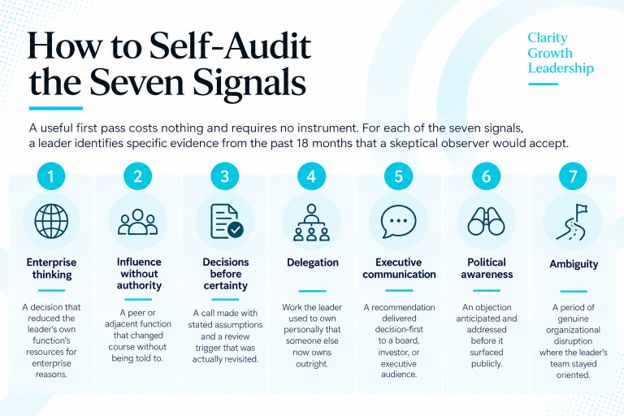
A useful first pass costs nothing and requires no instrument. For each of the seven signals, a leader identifies specific evidence from the past 18 months that a skeptical observer would accept.
- Enterprise thinking: a decision that reduced the leader’s own function’s resources for enterprise reasons.
- Influence without authority: a peer or adjacent function that changed course without being told to.
- Decisions before certainty: a call made with stated assumptions and a review trigger that was actually revisited.
- Delegation: work the leader used to own personally that someone else now owns outright.
- Executive communication: a recommendation delivered decision-first to a board, investor, or executive audience.
- Political awareness: an objection anticipated and addressed before it surfaced publicly.
- Ambiguity: a period of genuine organizational disruption where the leader’s team stayed oriented.
One caution keeps this exercise honest. Producing one example is not the same as demonstrating the behavior consistently at executive scale.
A single instance of influencing a peer group establishes that the behavior exists in the leader’s range, not that it operates reliably across a full executive stakeholder map under pressure.
Signals with no supportable evidence are development targets rather than verdicts, and the exercise identifies where to look rather than how ready a leader is. It deliberately produces no score.
How to Assess C-Suite Readiness Objectively
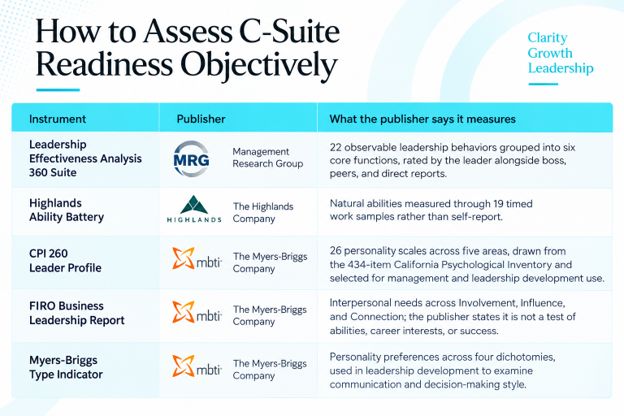
Objective assessment adds observer data and published instruments to the self-audit above. The instruments measure distinct constructs, and none of their publishers present the results as a definitive measure of C-suite readiness; rather as a correlative relationship to effective leadership. The intention is to use the instruments’ results as leadership coaching tools for the purpose of developing the seven behavioral signals.
Each contributes one input to a judgment that a coach and client reach together.
| Instrument | Publisher | What the publisher says it measures |
| Leadership Effectiveness Analysis 360 Suite | Management Research Group | 22 observable leadership behaviors grouped into six core functions, rated by the leader alongside boss, peers, and direct reports |
| Highlands LeadershipAbility Battery | The Highlands Company | Natural abilities measured through 19 timed work samples rather than self-report |
| CPI 260 Leader Profile | The Myers-Briggs Company | 26 personality scales across five areas, drawn from the 434-item California Psychological Inventory and selected for management and leadership development use |
| FIRO Business Leadership Report | The Myers-Briggs Company | Interpersonal needs across Involvement, Influence, and Connection; the publisher states it is not a test of abilities, career interests, or success |
| Myers-Briggs Type Indicator | The Myers-Briggs Company | Personality preferences across four dichotomies, used in leadership development to examine communication and decision-making style |
Multi-rater data carries particular weight for Sign #2, since influence exists only in other people’s experience of it.
Fettner is a Certified Administrator of the Leadership Effectiveness Analysis 360 Suite and a Highlands Leadership Ability Battery Certified Affiliate.
The assessment page lists the full set of career, personality, and ability tests used in these engagements, and results inform a development plan rather than a pass-fail verdict.
What to Do When the Answer Is Not Yet
A leader without supportable evidence on two or three signals is in a common and correctable position. Development work runs through stretch assignments rather than coursework, because the signals are behavioral, and behaviors need conditions to appear.
- Take a profit-and-loss assignment. Owning revenue and cost together turns enterprise thinking into a scored responsibility.
- Lead a cross-functional initiative with no direct reports. Influence without authority develops only where authority is unavailable.
- Request board or investor exposure. The executive register improves through repetition in front of the actual audience.
- Hand off the most valued technical work. Delegation capacity is visible in what gets released.
- Volunteer for a turnaround or integration. Ambiguity tolerance is demonstrable only in ambiguous conditions.
Each of these produces evidence across a full performance cycle rather than a quarter, which is why this work is planned in years rather than weeks. Sequencing matters more than volume.
MIT Sloan’s work with executive advisor Cassandra Frangos, published in its analysis of paths to the C-suite, identifies rigid personal deadlines for reaching an executive role as a common mistake among aspiring leaders, since organizational timing rarely cooperates.
Mapping the eventual move against a C-suite transition checklist keeps preparation and transition separate.
How Executive Coaching Prepares Professionals for the C-Suite
Executive coaching examines current behavior against all seven signals, then concentrates development on the two or three with the weakest supporting evidence.
The value sits in the diagnosis, since a leader who develops a capability that was not the constraint arrives no better positioned than before.
The stakes justify the rigor. McKinsey’s analysis of CEO transitions reports that one-third to one-half of new CEOs are considered to be failing within 18 months, and that more than 90% of those CEOs said they wished they had managed the transition differently. Examining readiness before an appointment costs considerably less than discovering it afterward.
Fettner engagements run on a proprietary six-step Discover–Achieve framework that begins with a Best-Fit Profile and carries through planning, positioning, offer evaluation, and first-year performance, so development targets are set from assessment data rather than from the leader’s own theory of the gap.
Marilyn Fettner’s clinical counseling training shapes how the interpersonal and political signals get worked, which are the two that generic leadership curricula tend to leave alone.
Frequently Asked Questions
How do I know if I’m ready for the C-suite?
Seven behaviors are worth examining: enterprise thinking, influence without authority, decisions before certainty, developmental delegation, executive communication, political awareness, and steadiness in ambiguity. Reviewing evidence for each shows where capability is established and where it is thin. This exercise identifies development targets rather than producing a conclusive readiness verdict.
What skills do you need for the C-suite?
Enterprise-level judgment, financial literacy across the whole business, stakeholder influence outside reporting lines, board-register communication, and tolerance for sustained ambiguity. Functional expertise is generally assumed at this level rather than evaluated, so depth in one discipline does less to differentiate candidates.
How do I know if I am executive material?
Observer data answers this more reliably than reflection. Multi-rater instruments such as the Leadership Effectiveness Analysis 360 show whether peers and direct reports observe the same behaviors the leader perceives. Gaps between self-rating and observer rating are the most useful discussion and coaching material.
How long does it take to prepare for a C-suite role?
No fixed timeline applies, since the behaviors develop through assignments and coaching rather than courses. Profit-and-loss ownership, cross-functional leadership without authority, and board exposure each produce evidence across a full performance cycle, which places this work in years rather than months.
Does an MBA make someone ready for the C-suite?
An MBA provides financial literacy and strategic vocabulary, both useful but not sufficient on their own. Political judgment, influence outside reporting lines, and tolerance for ambiguity develop through experience under pressure, and boards evaluate demonstrated behavior alongside credentials.
What assessments measure executive readiness?
No published instrument directly measures C-suite readiness conclusively. The Leadership Effectiveness Analysis 360 gathers multi-rater feedback on 22 leadership behaviors, the HighlandsLeadership Ability Battery measures natural abilities through timed work samples, and the CPI 260 measures personality scales relevant to leadership development. Coaches interpret them together.
Why do new executives fail in their first 18 months?
McKinsey reports that 68% of leadership transitions flounder on issues related to politics, culture, and people, and that one-third to one-half of new CEOs are considered to be failing within 18 months. Technical capability does not appear among the leading causes identified.
Can someone be ready for the C-suite without managing a large team?
Yes. Headcount reflects organizational scale rather than executive judgment. Leading 30 people through a strategic pivot can surface more of these seven behaviors than administering 500 inside a stable operating model, since the behaviors appear under complexity rather than volume.
Is readiness the same for every C-suite role?
No. Chief financial officer roles carry capital-markets obligations, chief human resources officer roles require labor and employment fluency, and chief executive appointments turn substantially on board relationships and succession timing. The seven behaviors describe general executive readiness rather than fit for one seat.
What should someone do after being passed over for an executive role?
Request specific feedback on which behavior(s) fell short, then compare that feedback against multi-rater assessment data. Being passed over often reflects one identifiable gap, a role-specific requirement, or organizational timing rather than a categorical judgment about general executive capability.
The Bottom Line
C-suite readiness is behavioral and observable before any promotion. Seven behaviors describe it: enterprise thinking, influence without authority, decisions before certainty, developmental delegation, executive communication, political awareness, and steadiness in ambiguity.
Tenure, title, headcount, technical depth, and an MBA describe something else. Published instruments measure leadership style, interpersonal needs, and abilities rather than readiness itself, so instrument data informs the judgment instead of settling it.
Readiness for general executive responsibility also differs from candidacy for one specific seat.
Executive readiness, when examined against evidence, beats readiness assumed from tenure. Fettner Executive & Professional Career Coaching examines both — book a consultation with Marilyn Fettner.