
Employer-Sponsored Executive Coaching: How Goals, Sponsorship, and Reporting Work
Employer-sponsored executive coaching is a coaching engagement in which an organization pays for and arranges executive coaching for one of its leaders.
Three parties share the work: the leader being coached, the sponsor who funds it, and the coach.
A written agreement sets who shapes the goals, how progress is tracked, and what the organization receives when the engagement closes.
Key Takeaways
- ICF’s Insights and Considerations for Ethics, revised February 2026, says the coaching agreement should define the sponsor’s rights, roles, and obligations whenever the sponsor is a separate party (Standard 1.1).
- The same ICF guidance asks coaches to clarify how they share reports, evaluations, and assessment results (Standard 2.2).
- ICF guidance under Standard 5.2 places goals and outcomes with the client and says coaches should not guarantee success.
- A 2022 SHRM case study describes one engagement in which the coach checked in with HR roughly every six weeks over six months, sharing brief progress updates.
HR leaders weighing coaching for a senior leader can ask about confidentiality during a no-cost consultation with Fettner Executive & Professional Career Coaching.
Who Sets the Goals When the Employer Pays?
The leader sets the coaching goals with the coach’s support, within a purpose the sponsor helps define.
The International Coaching Federation (ICF) is a professional association, and its Insights and Considerations for Ethics (ICE) is guidance for ICF Professionals, the coaches who present themselves as ICF members or credential holders. Other coaches and sponsors can use it as a reference rather than a binding rule.
ICE treats goals and outcomes as the client’s, while asking coaches to watch for coaching that works against the sponsor’s interests.
Goal setting in a sponsored engagement can draw on three inputs:
- Organizational purpose. A 2022 SHRM case study describes HR helping define an engagement’s requirements and expected outcomes and clarifying what each participant wants.
- Leader-owned goals. The leader turns that purpose into specific development goals, with the coach supporting the process rather than writing the goals.
- A review point. ICE guidance under Standard 4.3 suggests a process for the client and, where applicable, the sponsor to check whether the coaching still delivers value.
Raise competing priorities before anyone signs. ICE guidance under Standard 3.1 asks coaches to raise possible conflicts from multiple agreements with every party, and Standard 3.3 lists four ways to resolve issues: work it through with the parties, seek professional advice, suspend the engagement, or end it.
At Fettner Executive & Professional Career Coaching, goal work follows the Discover-Achieve framework. This six-step coaching process moves from Discover (assessments and guided discussion) through Explore, Plan, Market (when relevant), and Strategize, to Achieve.
Leadership development work at the practice uses leadership assessments to identify strengths and growth areas, and the leader builds a development plan from the results.
How Is a Three-Way Coaching Agreement Structured?
A three-way coaching agreement is a written agreement between the leader, the sponsor, and the coach that sets roles, goals, and information flow before coaching begins.
ICE guidance under Standard 1.1 recommends a written agreement where culturally appropriate and suggests naming the governing legal framework, especially for virtual or cross-border work. Drawing on ICE guidance, a sponsored engagement can follow six general stages:
| General Stage | Who Participates | What Is Agreed | What Is Reported |
| Sponsor intake | Sponsor and coach | Engagement purpose, expected outcomes, and the sponsor’s rights and roles | No coaching content exists yet |
| Chemistry call | Leader and coach | Fit, how coaching works, and how confidentiality will be handled | The decision to proceed, if the agreement calls for it |
| Three-way goal setting | Leader, sponsor, and coach | Goals, each party’s role, and which information reaches the sponsor | The agreed goals as written into the agreement |
| Coaching cycle | Leader and coach | Session schedule and development work | Only the items the agreement names, such as attendance |
| Mid-point check | Leader, sponsor, and coach | Whether the coaching still delivers value, and any re-clarified terms | Progress against the agreed goals at the agreed level of detail |
| Close-out | Leader and coach, with the sponsor where agreed | Closure, which ICE treats as optional, and any final report | A final report in the form the agreement sets |
ICE also suggests separate agreements for allied services such as assessments, and a briefing on the organization’s policies before the engagement starts.
Before founding her practice, Marilyn Fettner served as Director of Training at McCormick Place/Navy Pier and Director of Professional Development at the North Shore Board, so she has extensive experience overseeing development programs from inside organizations.
She is also a member of the Institute of Coaching, a coaching research community based at McLean Hospital in Belmont, Massachusetts, which is a member of Mass General Brigham, and the largest psychiatric affiliate of Harvard Medical School.
Her background and credentials include certification in the Highlands Leadership Ability Battery, and the Leadership Effectiveness Analysis (LEA) 360.
What Does the Organization Receive at the End of an Engagement?
The organization receives whatever the three-way agreement names as a deliverable, and ICE guidance does not promise any particular result. Under Standard 2.2, ICE lists the kinds of items an agreement should address:
- Reports. Summaries of progress against the agreed goals, at the level of detail the agreement sets.
- Evaluations. Any assessment of the engagement itself, such as whether the coaching delivered value for the leader and the sponsor.
- Assessment results. Instrument results, released only on the terms the agreement records.
ICE guidance under Standard 3.2 adds that contracts should state who can access reports beyond the people directly involved, and it notes that many coaches write the final report together with the client, so the client has input into the process.
Those are general terms a coach and sponsor can negotiate. At Fettner Executive & Professional Career Coaching, the practice’s own policy is stricter on one point: Marilyn Fettner shares nothing discussed in sessions with a client’s employer, board, or any other third party, with the exception of what’s stipulated in the agreement.
Organizations planning a leader’s development can ask how the practice handles session privacy during a first conversation with Fettner Executive & Professional Career Coaching.
How Is Progress Measured Without Breaching Confidentiality?
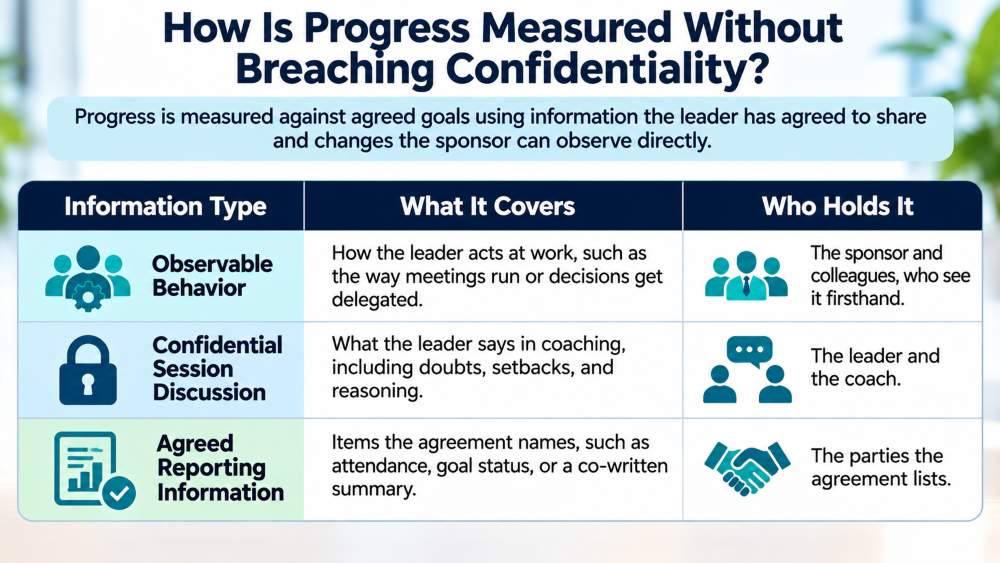
Progress is measured against the agreed goals using information the leader has agreed to share and changes the sponsor can observe directly. A sponsored agreement can keep three kinds of information separate:
| Information Type | What It Covers | Who Holds It |
| Observable behavior | How the leader acts at work, such as the way meetings run or decisions get delegated | The sponsor and colleagues, who see it firsthand |
| Confidential session discussion | What the leader says in coaching, including doubts, setbacks, and reasoning | The leader and the coach |
| Agreed reporting information | Items the agreement names, such as attendance, goal status, or a co-written summary | The parties the agreement lists |
A sample goal shows how the three types separate. A leader working on delegation might set a goal of handing off more operating decisions to direct reports.
The sponsor can observe whether fewer of those decisions reach the leader’s desk, and the leader’s reasons for holding onto them stay in the session under the engagement’s coaching confidentiality terms.
The agreed reporting item could be a short quarterly note the leader writes on progress toward the goal.
Multi-rater feedback adds a fourth view: the practice’s LEA 360 gathers ratings on 22 leadership practices from peers, direct reports, and supervisors, and every assessment includes a structured debrief with the leader.
ICE also warns that company-owned devices may be accessible to others, so the parties should agree on where to store coaching data.
What Should a Leader Ask Before Accepting Employer-Sponsored Coaching?
A leader should first ask three things: who wrote the goals, what the sponsor will receive, and how the leader can terminate coaching. Those answers decide how much control the leader keeps once coaching starts.
Questions to Ask Before Signing
- Which goals come from the sponsor, and which come from the leader? ICE places goal ownership with the client, and the practice’s executive coaching approach begins with the leader’s own assessments.
- What will the sponsor receive, and will the leader review it first? ICE notes that many coaches co-write reports with the client.
- What happens if the leader wants to stop? ICE guidance under Standard 1.2 says any party may end the engagement. This is usually required to include a timeframe for termination notification and that the notification is in writing.
- Why is the organization offering coaching now? The purpose shapes every goal that follows.
- Who sees assessment results? ICE asks coaches to clarify how results are shared.
- Does the coach hold any other role inside the organization? ICE cautions against mixing roles, such as investigating workplace conduct while coaching employees.
- Does the coach receive a referral fee? ICE guidance under Standard 3.8 calls for disclosing referral fees to the client or sponsor.
Common Mistakes in Sponsored Engagements
- Vague goals. A purpose such as “better leadership” is too vague because it gives the leader, sponsor, and coach nothing specific to measure as progress.
- Unwritten reporting permissions. ICE guidance under Standard 2.2 notes that terms may need re-clarifying mid-engagement, which is harder when nothing was written at the start.
- Unstated sponsor expectations. ICE guidance under Standard 1.1 asks for the sponsor’s rights, roles, and obligations to be stated in the agreement, because expectations that are left out carry no agreed-upon standing.
Leaders can still apply their own criteria when choosing an executive coach, since the leader does the work in every session and there needs to be a good fit between the coach and the leader. The practice coaches virtually from Northbrook, Illinois, with clients nationwide.
Frequently Asked Questions
Who is the sponsor in employer-sponsored executive coaching?
The sponsor is the person or organization that pays for, arranges, or defines the coaching, according to the ICF Code of Ethics. In an employer-sponsored engagement, the employer is the sponsor, and a 2022 SHRM case study describes HR initiating and facilitating the coaching contract.
What is a three-way coaching meeting?
A three-way coaching meeting brings the leader, the sponsor, and the coach together to agree on goals, roles, and information flow. The 2022 SHRM case study describes HR, the executive, and the coach agreeing on this triad model before that engagement began.
What is a chemistry call in executive coaching?
A chemistry call is an early conversation between the leader and the coach to test fit and explain how coaching works before signing any agreement. Fettner Executive & Professional Career Coaching offers a complimentary 30-minute consultation for this first conversation.
Can HR see what an executive discusses with a coach?
HR sees what the coaching agreement allows. ICE guidance under Standard 2.3 says information may go beyond the client only when the sponsor agreement permits it and the client agrees; the 2022 SHRM case study describes a coach sharing brief progress reports only.
How long does employer-sponsored executive coaching last?
The agreement sets the engagement length. Most engagements at Fettner Executive & Professional Career Coaching run three to twelve months, with biweekly or monthly sessions, and the engagement length shapes how many review points the parties schedule.
Can an executive coach guarantee results for the organization?
No. ICE guidance under Standard 5.2 says clients own their progress and outcomes, and coaches should not guarantee success. A sponsor can agree on goals and measurement methods with the leader and coach, but the results depend on the leader’s own work.
Can one coach work with several leaders in the same company?
One coach can work with several leaders in the same company, but ICE guidance under Standard 3.2 notes that external coaches with multiple clients in one organization can face conflicts of interest. The coach manages those conflicts through the agreement, self-reflection, and ongoing dialogue.
Are assessments covered by the main coaching agreement?
ICE guidance under Standard 1.1 recommends separate agreements for allied services such as assessments. A sponsored engagement that includes instruments like the CPI 260 Leader Profile or the LEA 360 can set the release terms for those results in their own agreement.
Bottom Line
Employer-sponsored executive coaching works through a written three-way agreement that sets the sponsor’s role, the leader’s goals, and the reporting terms before coaching starts.
ICF guidance keeps goal ownership with the leader and rules out guaranteed results. The organization receives the items named in the agreement, measured against goals the leader helped write.
Sponsors and leaders who want coaching confidentiality explained before the first session can arrange an introductory call with Fettner Executive & Professional Career Coaching.