
How Long Does Executive Coaching Take? Timeline and Phases Explained
Executive coaching engagements at Fettner Executive & Professional Career Coaching in Northbrook, Illinois, run three to twelve months depending on the scope of the leader’s objectives, the complexity of the presenting challenge, and the pace of documented behavioral change.
Marilyn Fettner, LCPC, CCC, NCC, CPVC, structures every executive coaching engagement around a four-phase methodology — Initial Assessment, Customized Coaching Plan, Ongoing Support, and Performance Evaluation — so the timeline responds to measurable progress rather than a fixed calendar.
Key Takeaways
- Executive coaching engagements typically run three to twelve months, with the timeline driven by leadership complexity and documented behavioral progress
- Every engagement at Fettner Executive & Professional Career Coaching follows four phases: Initial Assessment, Customized Coaching Plan, Ongoing Support, and Performance Evaluation
- Short engagements (three to four months) address focused short-term leadership challenges; full engagements (six to twelve months) produce sustained behavioral change and positive impact on organizational change
- According to ICF data, 86% of organizations that measured coaching ROI reported recouping their investment, with the strongest returns appearing in engagements lasting six months or longer
Build a coaching timeline that fits your leadership objectives. Schedule a fact-finding session with Fettner Executive & Professional Career Coaching today.
How Long Does Executive Coaching Take at the Senior Level
Executive coaching for C-suite leaders, VPs, and directors typically runs three to twelve months, with six to nine months being the most common range for engagements targeting sustained behavioral change. The timeline depends on the leader’s baseline, the number of leadership dimensions under development, and the organizational context that shapes the engagement.
A director preparing for a VP promotion with a focused short-term communication objective may complete a productive engagement in three to four months.
A C-suite executive navigating a complex organizational restructuring while addressing multiple leadership performance areas — decision-making, team dynamics, and executive presence — typically requires eight to twelve months to produce documented, lasting change.
According to ICF’s 2025 Global Coaching Study, the coaching industry now includes over 122,000 practitioners worldwide, and enterprise-level engagements most commonly span six to twelve sessions across a six- to twelve-month window.
The range exists because executive coaching is not a course with a set curriculum that applies to the goals of all executives. A “cookie-cutter” approach is not appropriate and should be a red flag if such an approach is suggested. The engagement advances when assessment data, behavioral observation, and stakeholder feedback confirm progress — not when a predetermined number of sessions have elapsed.
What Factors Determine Executive Coaching Timeline
Five variables drive variation in timelines for executive coaching engagements: scope of objectives, leadership level, organizational complexity, the leader’s readiness for behavioral change, and whether the presenting challenge has a clinical dimension requiring deeper assessment.
Scope and Leadership Level
A single-dimension engagement — strengthening leadership communication during a role transition, for example — moves faster than a multi-dimension engagement that addresses communication, delegation, strategic thinking, and interpersonal effectiveness simultaneously.
Senior leaders operating at the C-suite level face greater organizational complexity than mid-level managers, which typically extends timelines because behavioral changes must be tested across more stakeholder relationships and higher-stakes contexts.
Clinical Depth and Readiness
Engagement timelines also vary based on the presence of underlying patterns that coaching-only credentials may not detect.
Fettner Executive & Professional Career Coaching founder’s clinical licensure allows her to identify when a leadership challenge intersects with executive-functioning patterns, burnout-driven compensation behaviors, or emotional-regulation dynamics.
Leaders whose challenges carry these dimensions benefit from a longer engagement that addresses root causes rather than surface symptoms — so the behavioral changes hold under sustained organizational pressure.
What Happens in Each Phase of an Executive Coaching Engagement
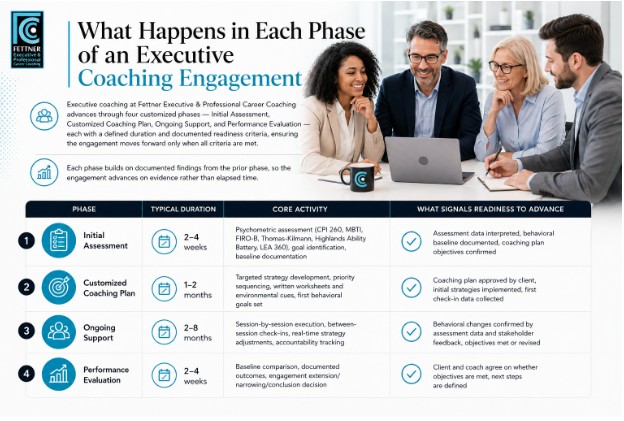
Executive coaching at Fettner Executive & Professional Career Coaching advances through four customized phases — Initial Assessment, Customized Coaching Plan, Ongoing Support, and Performance Evaluation — each with a defined duration and documented readiness criteria, ensuring the engagement moves forward only when all criteria are met.
Each phase builds on documented findings from the prior phase, so the engagement advances on evidence rather than elapsed time.
| Phase | Typical Duration | Core Activity | What Signals Readiness to Advance |
| Initial Assessment | 2–4 weeks | Psychometric assessment (CPI 260, MBTI, FIRO-B, Thomas-Kilmann, Highlands Ability Battery, LEA 360), goal identification, baseline documentation | Assessment data interpreted, behavioral baseline documented, coaching plan objectives confirmed |
| Customized Coaching Plan | 1–2 months | Targeted strategy development, priority sequencing, written worksheets and environmental cues, first behavioral goals set | Coaching plan approved by client, initial strategies implemented, first check-in data collected |
| Ongoing Support | 2–8 months | Session-by-session execution, between-session check-ins, real-time strategy adjustments, accountability tracking | Behavioral changes confirmed by assessment data and stakeholder feedback, objectives met or revised |
| Performance Evaluation | 2–4 weeks | Baseline comparison, documented outcomes, engagement extension/narrowing/conclusion decision | Client and coach agree on whether objectives are met, next steps are defined |
Professionals seeking a detailed breakdown of what each phase addresses can review the full executive coaching approach at Fettner Executive & Professional Career Coaching.
The session-level detail on the practice website explains how individual coaching sessions are structured within each phase.
Gain clarity on the right coaching timeline for your leadership goals. Schedule a session with Fettner Executive & Professional Career Coaching and identify your first step forward.
How Do Short-Term and Full-Length Engagements Compare
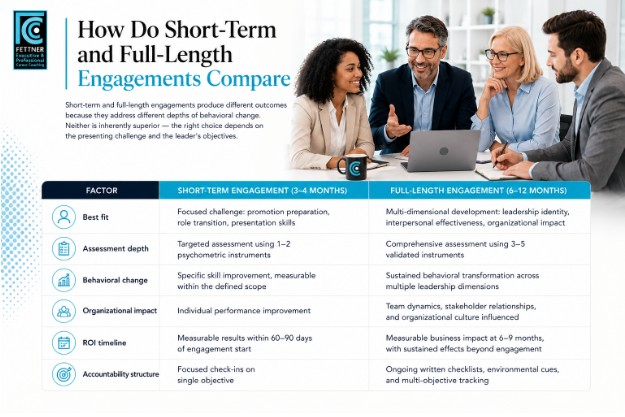
Short-term and full-length engagements produce different outcomes because they address different depths of behavioral change. Neither is inherently superior — the right choice depends on the presenting challenge and the leader’s objectives.
| Factor | Short-Term Engagement (3–4 Months) | Full-Length Engagement (6–12 Months) |
| Best fit | Focused challenge: promotion preparation, role transition, presentation skills | Multi-dimensional development: leadership identity, interpersonal effectiveness, organizational impact |
| Assessment depth | Targeted assessment using 1–2 psychometric instruments | Comprehensive assessment using 3–5 validated instruments |
| Behavioral change | Specific skill improvement, measurable within the defined scope | Sustained behavioral transformation across multiple leadership dimensions |
| Organizational impact | Individual performance improvement | Team dynamics, stakeholder relationships, and organizational culture influenced |
| ROI timeline | Measurable results within 60–90 days of engagement start | Measurable business impact at 6–9 months, with sustained effects beyond engagement |
| Accountability structure | Focused check-ins on single objective | Ongoing written checklists, environmental cues, and multi-objective tracking |
According to ICF research, 86% of organizations reported positive ROI from coaching engagements, and a PricewaterhouseCoopers survey found an average return of seven times the cost of employing a coach.
The MetrixGlobal study cited by ICF documented a 529% ROI from structured executive coaching, with the strongest returns appearing in engagements that ran six months or longer and included documented behavioral measurement.
When Do Leaders Start Seeing Results from Executive Coaching
Early behavioral shifts — improved clarity in decision-making, sharper communication in high-stakes conversations, and stronger self-awareness around leadership patterns — typically emerge within the first four to six sessions.
These early results reflect the Customized Coaching Plan phase, in which targeted strategies begin to produce observable changes in daily leadership behavior.
Sustained organizational impact — team performance improvements, changes in stakeholder relationships, and measurable shifts in leadership effectiveness — typically requires four to six months of consistent coaching.
The longer timeline reflects the reality that behavioral change must be tested under repeated organizational pressure before the new patterns replace the old ones.
The ICF framework for measuring coaching ROI distinguishes between short-term behavioral signals (improved stakeholder feedback, shifts in decision quality) and longer-term business impact (retention, engagement, revenue), with most organizations reporting the strongest measurable business returns at the nine- to twelve-month mark.
Marilyn Fettner provides written worksheets, checklists, and environmental support cues as part of every engagement, so coaching strategies translate into daily leadership behavior between sessions rather than remaining theoretical.
How to Choose the Right Engagement Length for Your Situation
The right engagement length depends on three factors: how many leadership dimensions need development, how deeply the presenting challenge is embedded in the leader’s behavioral patterns, and how much organizational complexity surrounds the role.
A leader with a focused objective — preparing for a board presentation, strengthening performance under a new reporting structure, or navigating a specific interpersonal conflict — may accomplish meaningful progress in three to four months.
A leader whose challenge spans leadership identity, team dynamics, and executive life balance typically needs six to twelve months to produce the depth of change that holds under sustained pressure.
Marilyn Fettner evaluates engagement scope directly during a free 15-minute fact-finding session and recommends a realistic timeline based on the leader’s presenting situation.
All sessions at the practice are delivered virtually via phone or video, one-on-one, to senior professionals across all 50 U.S. states. Leaders uncertain whether their situation calls for coaching can review the practice website’s assessment of whether executive coaching is a fit for their presenting challenge.
Frequently Asked Questions
How long does executive coaching take?
Executive coaching engagements at Fettner Executive & Professional Career Coaching run three to twelve months. Timeline depends on leadership objectives, challenge complexity, and documented behavioral progress. Six to nine months represents the most common range for senior leaders seeking sustained change.
What are the four phases of executive coaching?
The four phases are Initial Assessment, Customized Coaching Plan, Ongoing Support, and Performance Evaluation. Each phase builds on documented findings from the prior phase, so the engagement advances based on measurable progress rather than a fixed session count or predetermined calendar.
How soon will I see results from executive coaching?
Early behavioral shifts typically emerge within the first four to six sessions, including improved decision clarity and sharper communication in high-stakes settings. Sustained organizational impact, including changes in team performance and stakeholder relationships, typically requires four to six months of consistent coaching.
Can executive coaching be completed in three months?
A three-month engagement can produce meaningful results when the leader’s objective is focused on a single dimension, such as promotion preparation, role transition, or presentation skills. Multi-dimensional leadership development typically requires 6 to 12 months to achieve sustained, documented behavioral change.
What determines how long executive coaching takes?
Five variables drive variation in timelines for executive coaching engagements: the scope of leadership objectives, the current leadership level, the organizational complexity surrounding the role, the leader’s readiness for behavioral change, and whether the presenting challenge involves underlying patterns that require clinical-depth assessment beyond standard coaching.
How often are executive coaching sessions held?
Coaching sessions at Fettner Executive & Professional Career Coaching are typically held weekly or biweekly, depending on the engagement phase and the leader’s organizational calendar. Between-session check-ins and written accountability tools maintain momentum between formal sessions are part of the engagement.
Is executive coaching available virtually?
All coaching sessions at Fettner Executive & Professional Career Coaching are delivered virtually videoconference, one-on-one, and available to senior professionals across all 50 U.S. states including the Southwest Florida area, such as Naples, Bonita Springs, Estero, Fort Myers, Sarasota, and Tampa.
What is the ROI of executive coaching?
According to ICF data, 86% of organizations that measured coaching ROI reported recouping their investment. A PricewaterhouseCoopers survey found an average return of seven times the cost of employing a coach, with the strongest returns appearing in structured engagements lasting six months or longer.
How is coaching progress measured?
Progress is measured through psychometric reassessment, behavioral observation, stakeholder feedback, and documented comparison against the baseline established during the Initial Assessment phase. The Performance Evaluation phase formally compares leadership behavior outcomes against original engagement objectives to determine whether the coaching extends, narrows, or concludes.
What happens after the executive coaching engagement ends?
The Performance Evaluation phase includes a documented review of outcomes and a decision on whether the engagement extends, narrows in scope, or concludes. Leaders retain all written materials, checklists, and strategies developed during the engagement and can schedule periodic check-in sessions as needed.
Take the guesswork out of your executive coaching timeline. Schedule a fact-finding session with Fettner Executive & Professional Career Coaching and walk away with a realistic plan for your leadership development.