

Psychological Safety at the Executive Table: Proven Coaching Tactics for High-Performing Leadership Teams
Executive teams often talk about psychological safety, but the reality at the executive table is harsher than the slogan. Executive-team dynamics differ from those in the rest of the organization.
Executive decision-making suffers when leaders cannot challenge assumptions, ask basic questions, or admit uncertainty. Organizational blind spots grow when executive leaders avoid dissent and clarity.
Many leaders assume senior teams “naturally” have psychological safety because executive leaders carry authority and experience. Executive authority does not guarantee psychological safety.
Status hierarchies, political maneuvering, and fear of appearing incompetent often undermine psychological safety at the executive level. The CEO or meeting chair sets the tone for executive-team candor through visible responses to questions and dissent.
Executive coaching converts psychological safety from a concept into a repeatable meeting practice. Executive coaching is most effective when it uses specific tactics rather than generic encouragement.
Practical coaching includes meeting-ready scripts, observable behaviors to track, and a decision routine that increases openness without weakening accountability.
Executive teams gain a durable competitive advantage when executives challenge each other respectfully and surface hard truths early.
Key Takeaways
- Executive psychological safety improves fastest when the CEO/Chair changes first-response behaviors to dissent.
- Meeting design (agenda inserts + explore/decide separation) creates repeatable safety without lowering standards.
- Behavior tracking beats generic culture talk; measure dissent events, premise-challenging questions, and uncertainty acknowledgments.
What Psychological Safety Means At The Executive Table (And What It Doesn’t)

At the executive level, psychological safety operates differently than psychological safety in front-line teams. Executive-team stakes include organizational direction, capital allocation, and reputations built over decades.
Psychological safety and accountability can coexist. Psychological safety increases truth-telling and early risk surfacing. Accountability converts candid input into clear decisions, owners, and follow-through.
The Executive-Table Version: Reputation, Power, And Time Pressure
Sitting at the executive table, psychological safety doesn’t mean softening debate. It means you can challenge the CEO’s strategic direction without fearing for your career.
Your CFO can admit uncertainty about a financial model without losing credibility. Executive scrutiny increases reputational risk and raises the perceived cost of being publicly wrong.
You’ve spent years building your professional reputation, and every statement gets scrutinized by board members, investors, and direct reports.
Time makes things more complicated. Executive decisions happen fast, often with incomplete information. You need to voice concerns quickly, even if your argument isn’t fully formed yet.
Fostering psychological safety at this level means allowing executives to ask fundamental questions—even those that may seem obvious or challenge long-held beliefs.
Power dynamics shift everything. When the person across the table controls budgets, promotions, and strategic priorities, speaking up requires trust that goes well beyond typical workplace relationships.
The 3 Misconceptions That Quietly Kill Candor
Misconception 1: Psychological safety means avoiding conflict
Psychological safety supports disagreement, not conflict avoidance. Healthy executive teams debate strategy, resources, and risk with intensity. Psychological safety prevents disagreement from damaging relationships or careers.
Misconception 2: Declaring “this is a safe space” creates trust
Simply making a verbal declaration does not create psychological safety. Consistent executive behavior does create trust that builds over time. Trust collapses when an executive raises a concern and receives punishment.
Misconception 3: Psychological safety is about protecting feelings
Psychological safety does not prioritize comfort or low stress. Psychological safety ensures critical decisions face tough questions and uncomfortable realities. Executive teams should challenge weak ideas and avoid protecting egos.
Why Psychological Safety Breaks Down At Senior Levels

Senior leaders face unique pressures that make honest dialogue tough. The stakes feel higher, vulnerabilities seem riskier, and distance—both physical and emotional—creates trust gaps.
We’re Aligned Vs. We’re Avoiding The Real Conversation
Your executive team might appear unified in meetings, but that surface-level agreement can mask deeper concerns. When leaders nod along but keep doubts to themselves, you’re not building consensus—you’re dodging conflict.
Senior leaders worry about looking uncertain or undermining colleagues. You might hesitate to question a peer’s strategy in front of the CEO. Speaking up can feel riskier than staying quiet.
Research shows that middle managers feel less psychologically safe than both their bosses and their teams, but executives feel this too. Raising concerns might seem like a threat to your reputation or career.
The result? False harmony. Your team says “we’re aligned,” but really, you’re just avoiding tough conversations. Important issues never get addressed because everyone waits for someone else to speak up first.
Hybrid/Remote Leadership Teams: Why It’s Harder Now
Hybrid and remote executive teams often experience weaker psychological safety because informal relationship-building time is reduced, and real-time meeting cues are harder to read.
Fewer informal touchpoints reduce early risk-surfacing, because executive leaders raise sensitive concerns more often in low-stakes side conversations than in formal meetings.
If your executive team meets in person only once a quarter, you lose the relationship-building that enables honest dialogue.
Screen fatigue sets in. It’s easier to stay muted or keep your camera off than to interrupt a virtual presentation. Body language cues—those tiny signals of disagreement or confusion—disappear on video calls.
Distance also weakens accountability. When you don’t see your peers regularly, it’s tempting to skip tough feedback or avoid hard conversations altogether.
Fettner Executive & Professional Career Coaching helps leadership teams turn candor into better decisions through structured executive coaching—start strengthening executive dialogue today. Schedule a consultation.
Executive-Team Diagnostic — Spot The Signals In 15 Minutes
An executive-team diagnostic can surface psychological safety gaps in 15 minutes. A short diagnostic identifies how an executive team communicates, disagrees, and makes decisions under pressure.
A 5–10-minute pulse survey can measure executive team dynamics, meeting effectiveness, and interaction quality. A strong diagnostic combines survey responses with direct observation of executive-meeting behavior.
Use the following warning signs as diagnostic flags:
- Executive team members stay quiet during strategic discussions.
- Executive disagreements shift to private conversations rather than executive meetings.
- Executive leaders avoid challenging peer assumptions and proposals.
- The executive group reaches an agreement quickly without evidence-based debate.
A psychological safety diagnostic should assess interpersonal risk-taking behavior in executive meetings.
The diagnostic should measure whether executive leaders raise concerns, acknowledge mistakes, and challenge the status quo without fear of reputational or career consequences.
Key Areas to Evaluate
| Category | What to Look For |
| Speaking Up | Executive leaders contribute across roles and seniority levels. |
| Conflict Handling | Executive leaders disagree directly and respectfully during meetings. |
| Mistake Tolerance | Executive leaders discuss errors openly and learn from them. |
| Risk-Taking | Executive leaders propose unconventional ideas and surface downside risks. |
Low psychological safety drives groupthink and delays difficult conversations. A diagnostic should identify where groupthink appears in executive meeting patterns.
A practical assessment prioritizes observable behaviors over general sentiment.
A strong diagnostic asks about specific moments from recent executive meetings, because meeting-specific examples produce actionable data for immediate coaching and facilitation changes.
Fettner Executive & Professional Career Coaching works with senior leaders to improve executive communication, decision hygiene, and conflict repair in high-stakes meetings.
The tactics in this guide focus on observable behaviors and repeatable meeting mechanics, so executive teams can increase candor without lowering standards.
Coaching Tactics That Work (Scripts, Not Slogans)
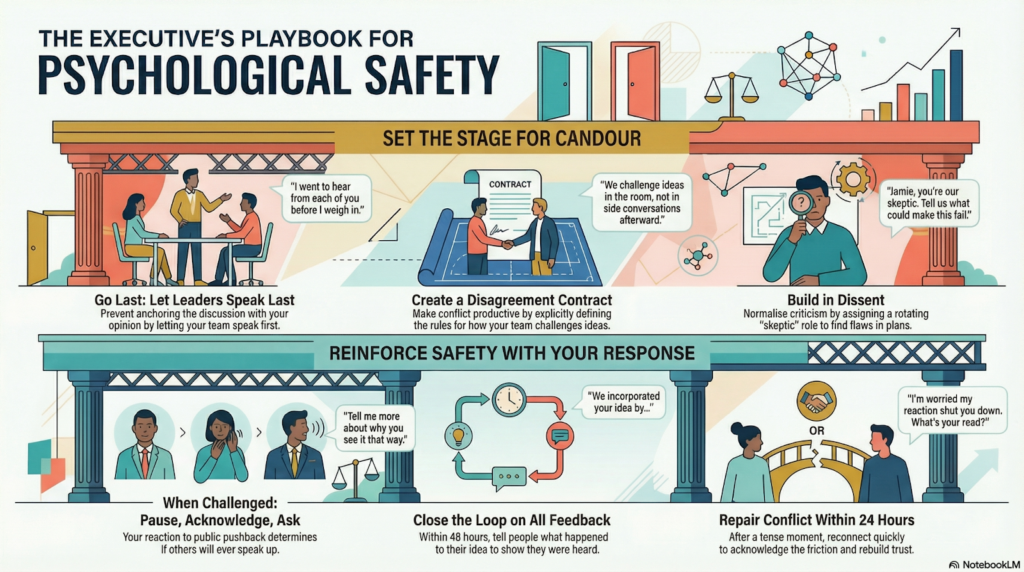
Executives need concrete language and structured practices to foster psychological safety at the leadership table.
These seven tactics provide specific language and rituals to help people speak up, disagree, and repair relationships when tensions run high.
Tactic 1 — The “Last-to-Speak” Rule For The Highest-Status Person
Go last when the topic matters most. This simple shift changes the power dynamic in your executive meetings by keeping your opinion from anchoring everyone else’s thinking.
Before opening a strategic discussion, say: “I want to hear from each of you before I weigh in.” Then actually stay quiet. Take notes, don’t nod or shake your head.
Your silence gives space for dissenting views. Junior voices speak up more freely when they don’t know where you stand yet.
When you do speak, acknowledge what you heard first. Try: “I heard three different approaches,” before you add your own view. It shows you listened, not just waited to talk.
This practice takes discipline. You’ll want to jump in early—especially if you already have a strong opinion. Resist that urge. Going last signals that other perspectives matter as much as yours.
Tactic 2 — The Disagreement Contract (How We Challenge Each Other Here)
Set explicit norms for how your team disagrees before conflict happens. Write down three to five specific behaviors everyone agrees to use when challenging ideas.
Your contract might include: “We challenge ideas in the room, not in side conversations afterward,” or “We ask questions before stating objections.” Post these agreements where everyone can see them during meetings.
The power is in making the invisible visible. Most teams have unspoken rules about disagreement that favor certain voices and silence others. When you make expectations explicit, you remove the guesswork about what’s safe to say.
Review your contract every quarter. Ask, “Are we actually following these norms?” Change them based on what’s working. Let the document evolve as your team’s needs shift.
If someone breaks the agreement, call it out directly: “Our contract says we challenge ideas here, not later. What’s your concern right now?”
Tactic 3 — The Built-In Dissent Ritual: “What Could Make This Fail?”
Build disagreement into your decision process by appointing someone to identify flaws. It’s not about being negative—it’s about catching risks before they sneak up on you.
Rotate the skeptic role so everyone gets practice speaking up against whatever’s popular. Try, “Jamie, you’re our skeptic this time. Take five minutes and tell us what could fall apart.”
This ritual removes the awkwardness of disagreement. When you expect and assign dissent, people stop worrying about looking difficult.
After the skeptical view, thank that person directly. Say, “That’s exactly what we needed to hear.” It shows the team that criticism matters.
Write down the concerns. Show people their dissent shapes decisions by addressing each point in your final plan. Folks keep challenging ideas when they see their input actually changes things.
Tactic 4 — The “Draft Thinking” Permission Statement (Stop Over-Polishing)
Give your team permission to share half-formed ideas. Start your own thoughts with, “I’m thinking out loud here,” or “This is half-baked, but…”
If someone brings you a polished deck, ask for the messy version: “Before we look at the slides, what are you still unsure about?” That way, you show you care about the process, not just the shiny end result.
Create meetings where rough ideas are the whole point. Label them clearly: “This is a rough ideas session—nothing needs to be perfect.” That frame allows people to ask for help and speak openly, free from judgment.
Model imperfection yourself. Admit your blind spots and say, “I don’t have this figured out yet,” even if it’s not true.
Tactic 5 — The Response Framework When Someone Pushes Back Publicly
Your initial response to public disagreement signals whether candor is truly safe. Try this three-part move when someone challenges you:
Pause. Take a breath. Count to three if you need to. It stops your knee-jerk defense.
Name what they did. Say, “You raised a concern that’s different from my view,” or “You’re seeing a risk I missed.” Acknowledge their guts without agreeing or disagreeing yet.
Ask a question. Invite them in: “Tell me more about why you see it that way,” or “What data are you looking at?” Questions show real interest, not just debate.
You don’t have to agree with the challenge to validate the act of speaking up. Your response might take only 30 seconds, but it can change the team’s overall tone.
Tactic 6 — The Close-the-Loop Move That Makes Candor Repeatable
Let people know what happened with their input. The follow-up decides if they’ll speak up again.
Within 48 hours of someone raising a concern, circle back with one of three updates: “We incorporated your idea by…,” or “We didn’t use your suggestion because…,” or “We’re still deciding, and here’s where we are.”
The specifics matter less than the fact that you acknowledged them. People just want to know you heard them—even if you didn’t take their advice.
For lasting psychological safety, track who speaks up in meetings. If someone shares and you never close the loop, they’ll go quiet next time.
Make it a habit. Jot down who raised what, and check off each follow-up as you go.
Tactic 7 — The 60-Second Repair Move After Conflict
Tension’s inevitable, even on strong teams. How quickly you repair after conflict decides if trust survives or shatters.
Use this within 24 hours of a heated moment: “I want to circle back on our conversation yesterday. I value your perspective, and I’m worried my reaction might have shut you down. What’s your read?”
The Executive Meeting Operating System: Where Safety Is Won Or Lost
Executive teams typically lose psychological safety in recurring executive meetings, not in private conversations. Agenda design, discussion structure, and conflict handling determine whether executive leaders speak up or self-censor.
Agenda Inserts That Create Safety Without Adding Time
Executive teams can embed psychological safety into meeting design without extending meeting length.
Start each executive meeting with a two-minute check-in. Ask each executive leader to share one word that describes their current bandwidth or stress level. The two-minute check-in helps executive leaders enter the meeting with shared context.
Add a standing agenda prompt: “What are we not discussing?” Reserve three minutes at the end of every executive meeting for that question. The prompt surfaces avoided topics and normalized the naming of sensitive issues.
Rotate facilitation responsibilities across executive leaders. Shared facilitation reduces over-dominance by one voice and increases participation across functions.
Create a recurring “challenge slot” for a contrarian viewpoint. Assign the contrarian role before the meeting so dissent becomes routine instead of personal.
Decision Hygiene: Separate “Explore” Meetings From “Decide” Meetings
Mixed meeting types quickly erode psychological safety. Executive leaders stop sharing honest input when an “exploratory” meeting turns into a decision-making meeting without warning.
Use exploration meetings to generate options, identify risks, and surface concerns. Set a clear rule: exploration meetings produce inputs and alternatives, not final decisions.
Use decision meetings to evaluate pre-defined options against explicit criteria. Share decision options and evaluation criteria in advance, so executive leaders can prepare.
Label meetings with intent on the calendar using clear tags such as [EXPLORE] or [DECIDE].
Reinforce the meeting type during facilitation when the group drifts into decision-making during an exploration meeting. Schedule a decision meeting when the executive team needs commitment.
Meeting separation protects candor because executive input does not immediately lock the organization into a commitment.
Executive leaders speak more directly when the meeting structure removes premature commitment pressure.
How To Facilitate High-Conflict Topics Without Public Humiliation
High-stakes disagreements require facilitation that protects dignity while preserving rigor.
Collect written input 24 hours in advance for controversial topics. Written input prevents early anchoring by the loudest voice and creates equal access to the floor.
Use “disagree and commit” language during tense discussions. State the process explicitly: “The executive team should surface all perspectives now, then align behind the final decision.”
Apply the “strong opinions, weakly held” technique. Ask each executive leader to rate conviction from 1–10, then ask high-conviction leaders to name the data that would change the rating.
Use issue isolation during interpersonal friction. Keep the business issue in the group meeting and move the relationship conflict to a separate one-on-one conversation.
Stop public criticism of absent stakeholders. Pause the discussion when the executive team targets someone who is not present, and schedule a meeting with the relevant leader included.
Suppose your executive meetings feel polite but are unproductive. Structured coaching from Fettner Executive & Professional Career Coaching can restore healthy challenge and trust. Contact us to begin.
Coach The CEO/Chair First (Because The Table Mirrors The Highest-Status Person)
The exec team takes cues from whoever holds the most power. If you coach the CEO or chair to show vulnerability and openness, everyone else follows suit.
The CEO Behavior Checklist That Raises Safety Fast
You need concrete actions, not just good intentions. Start with these specific behaviors your CEO can use right away:
Observable Actions:
- Ask at least two clarifying questions before sharing an opinion
- Openly credit the person whose idea you’re building on
- Admit “I was wrong about X” at least once a quarter in public
- Pause for three seconds after someone finishes before responding
- Thank people specifically for disagreeing with you
Track these actions weekly. Executive coaching for CEOs works best when you measure actions, not just feelings.
One tactic stands out: have your CEO openly name their own uncertainty. When they say, “I’m not sure how to solve this,” or “I need help thinking this through,” it sets the tone. The rest of the room will follow.
The One Reflex To Eliminate: “Debating The Feedback” In Real Time
When someone gives your CEO feedback or disagrees, the urge to defend or debate kills psychological safety on the spot. People watch the CEO’s face and words to see if honesty gets punished.
Coach your CEO to swap debate for curiosity. The goal isn’t agreement—it’s understanding.
The replacement script:
- “Tell me more about that.”
- “What led you to that conclusion?”
- “What am I missing?”
Save your counterpoints for later, after the person feels heard. Executive coaches often use role-play to break the debate reflex, practicing neutral expressions and open body language during mock criticism.
This takes practice. Most CEOs have trained themselves for years to jump in with quick answers and sharp rebuttals.
Pre-Wiring Without Politics: Ethical 1:1 Alignment Before Meetings
Pre-wiring means speaking with key people individually before a group meeting to gather their views and concerns. Poorly done, it’s a manipulation. When done well, it improves safety by reducing surprises and allowing people to be vulnerable in private first.
The ethical way: pre-wire to understand, not to lobby. Your CEO should ask, “What’s your view?” instead of, “Here’s why you should back me.”
The framework:
- Set up brief one-on-ones before tough decisions
- Ask about concerns, not just positions
- Share info that helps people prep, not scripts telling them what to say
- Name disagreements you’ve found, so no one’s blindsided in the meeting
Building trust between the chair and the CEO requires this kind of preparation. When people know where others stand ahead of time, they can approach disagreements thoughtfully rather than defensively. The group meeting becomes a place to work on solutions, not fight surprise battles.
Measurement Without Theater: Track Behaviors, Not Vibes
Executives need real data points that show if leaders actually create room for dissent—not just survey scores that turn into political theater.
Focus on tracking specific behaviors in meetings and on a clear outcome that demonstrates how psychological safety leads to better decisions.
The 3 Pulse Questions (1–5 Scale) That Actually Predict Candor
Ask your executive team these three questions after each major decision meeting. Rate responses from 1 (strongly disagree) to 5 (strongly agree).
Question 1: “I felt able to challenge the proposed direction without concern for my reputation.”
Question 2: “Others directly questioned assumptions, even when it might have been uncomfortable.”
Question 3: “I shared information that contradicted the leading perspective.”
These questions dig into real behavior, not just vague feelings about team culture. When you measure psychological safety using behavioral indicators, you see whether people actually spoke up when it mattered.
Track the three-item pulse after major decision meetings and monitor the trend across four to six meetings.
A sustained decline signals increased self-censorship during critical decisions. A sustained improvement signals growing comfort with direct challenge and the surfacing of risk.
The 3 Observable Behaviors To Track Meeting-By-Meeting
Have someone count these behaviors during executive meetings. This adds accountability without bogging things down.
Behavior 1: Direct disagreements are stated openly. Count every time an exec says “I disagree” or “I see it differently.” If they hedge with “just a thought,” skip it.
Behavior 2: Questions that challenge premises. Track questions that poke at the foundation of a proposal. “Why are we assuming this market will respond?” counts, but “When do we launch?” doesn’t.
Behavior 3: Leaders acknowledge their own uncertainty. Look for executives who admit, “I don’t know” or “I’m not sure,” rather than pretending to be confident. Psychological safety lets smart people do brave work together when leaders show some vulnerability.
Drop these counts into a simple spreadsheet. Don’t stress about your starting point—just watch how things shift over three months.
The 1 Outcome Proxy That Signals Better Decision Quality
Track how many big decisions get revised within 30 days. This one metric tells you if your team is making decisions with full info or just following the herd.
Each month, figure out your revision rate. Divide the number of major decisions that needed real changes by the total number of major decisions.
Track the 30-day decision revision rate as a trendline. A rising revision rate can signal rushed decisions, weak option testing, or suppressed dissent during the original meeting.
A near-zero revision rate can signal low challenge or untested assumptions. Use the trend to adjust meeting structure, dissent rituals, and decision criteria.
This outcome proxy for decision quality ties psychological safety to business results. Ultimately, it shows whether candor helps your strategy.
30-Day Executive Coaching Rollout Plan
You can start building psychological safety in your executive team within 30 days. There’s no need to disrupt daily operations.
This rollout plan breaks the process into manageable weekly actions. You can fit these steps into your existing schedule without much hassle.
Week 1: Foundation
- Meet with each executive one-on-one for 30 minutes. Explain the coaching approach in your own words.
- Share what psychological safety really means. Talk about why it matters for your leadership team—don’t just recite definitions.
- Ask each executive to recall a time when they held back their honest opinion. It’s usually more common than anyone admits.
Week 2: First Group Session
- Hold your first 60-minute coaching session with the full executive team. Try to keep it relaxed, not formal.
- Set two ground rules: no idea is too small to share, and disagreement is not just allowed—it’s encouraged.
- Ask everyone to share a professional concern. No judgment. Just listen.
Week 3: Individual Check-ins
- Set up quick 15-minute check-ins with each leader. Keep it informal.
- Ask what felt comfortable—or awkward—during the group session. Allow them to be honest, even if it’s not what you want to hear.
- This step helps you identify concerns before they escalate into larger issues. Don’t skip it.
Week 4: Building Momentum
- Run your second group coaching session, focusing on real business challenges. Don’t shy away from the tough stuff.
- Have executives practice disagreeing respectfully about a current decision. The skill requires deliberate practice, and the practice produces measurable improvements in decision quality and relationship repair.
- Wrap up by asking everyone to name one thing they learned about a colleague. The prompt often surfaces previously unspoken constraints and assumptions across functions.
You don’t need fancy coaching plan templates to get started. Give these four weeks a try and see what your team needs next.
Design executive meetings where leaders can speak honestly, challenge assumptions, and make quality decisions, with tailored coaching support from Fettner Executive & Professional Career Coaching. Schedule an appointment.
Frequently Asked Questions
What is psychological safety in an executive team?
Psychological safety in an executive team is the shared belief that leaders can speak up with ideas, questions, concerns, and mistakes without negative social or career consequences—so that strategic decisions get challenged and improved rather than protected by silence.
Why does psychological safety matter in leadership teams?
Psychological safety matters in leadership teams because it reduces interpersonal fear and increases truth-telling. Leaders surface risks sooner, test assumptions more rigorously, and learn faster from mistakes, which improves decision quality, execution, and adaptability under pressure.
Does psychological safety mean avoiding conflict?
Psychological safety does not mean avoiding conflict. Psychological safety enables direct, respectful disagreement and “learning-zone” debate, while accountability keeps standards high. Teams can challenge ideas hard, own decisions, and follow through without punishing candor.
How can a CEO quickly build psychological safety?
A CEO can build psychological safety by inviting participation, leveling power gradients, and responding productively when someone speaks up. Establishing clear norms for debate and handling mistakes makes dissent routine, so executives contribute earlier and more honestly.
How do you measure psychological safety in a leadership team?
Measure psychological safety with a short pulse survey and structured observation. Track whether leaders raise concerns, admit mistakes, ask premise-challenging questions, and disagree openly in meetings. Use Edmondson-style items repeatedly to monitor trends over time.
How do you build psychological safety in remote or hybrid executive teams?
Remote executive teams build psychological safety by creating deliberate “informal” touchpoints and stronger meeting mechanics. Use written pre-reads, round-robin input, and explicit dissent slots so quieter leaders contribute, and disagreement happens in the room, not in side chats.
What should a CEO do when an executive disagrees in a meeting?
When an executive challenges the CEO, the CEO should pause, acknowledge the concern, and ask a clarifying question before advocating a position. This first response signals whether speaking up is safe and valued, and whether future dissent will be acknowledged, rewarded, or punished.