
Executive Coaching in Northbrook, Illinois — Fettner Executive & Professional Career Coaching
Executive Coaching
Executive coaching at Fettner Executive & Professional Career Coaching helps mid-level managers, directors, VPs, and C-suite executives strengthen leadership presence, sharpen decision-making, and communicate with authority across complex organizations.
Marilyn Fettner, LCPC, CCC, NCC, CPVC, has coached more than 3,000 clients over 25 years through one-on-one engagements built around each leader’s challenges — not a template.
Every engagement begins with a structured leadership assessment and produces a customized action plan with quarterly progress benchmarks, delivered virtually nationwide from Northbrook, Illinois.
Key Takeaways
- Fettner Executive & Professional Career Coaching provides private, one-on-one executive coaching for mid-level managers, directors, VPs, and C-suite executives navigating transitions, performance demands, and organizational complexity.
- Each engagement uses validated assessments — CPI 260, Highlands Ability Battery, FIRO Business Leadership Report, and LEA 360 — to establish a baseline before coaching begins.
- The practice brings more than 25 years of coaching experience across industries that include healthcare, technology, manufacturing, law, education, and financial services.
- Virtual coaching is available nationwide, in all 50 states, including the Greater Chicago area and Southwest Florida.
Gain clarity on your next leadership challenge — schedule a 30-minute fact-finding session with Fettner Executive & Professional Career Coaching and walk away with a concrete first step forward.
What Is Executive Coaching and Who Is It For?
Executive coaching is a structured, one-on-one professional development process in which a credentialed coach partners with a leader to strengthen targeted competencies, resolve defined challenges, and accelerate progress toward career and leadership objectives.
The International Coaching Federation’s Core Competency Model establishes coaching as a thought-provoking and creative partnership that inspires clients to maximize personal and professional potential.
Executive coaching at Fettner Executive & Professional Career Coaching follows this standard while adding the clinical depth that comes from Marilyn Fettner’s training as a Licensed Clinical Professional Counselor.
The professionals who benefit most from executive coaching share a common profile: they are already accomplished, already capable, and already performing — but they face challenges that competence alone cannot solve.
A common challenge might be a promotion into a bigger role, a team that has outgrown the leader’s current management approach, political complexity at the organizational level, or a performance plateau that effort and hours cannot break through.
Mid-Level Managers and Directors Stepping Into Larger Roles
Mid-level managers and directors often reach a point where the functional expertise that earned them their titles no longer generates forward momentum.
The jump from managing tasks to leading people, and from leading people to influencing strategy, requires a different set of skills so the leader can earn credibility at the next level before the promotion creates pressure to perform immediately.
Executive coaching identifies the gap — whether that gap involves communication across cross-functional teams, stakeholder management, or executive presence — and builds targeted capacity within the first 90 days of the engagement.
VPs and C-Suite Executives Navigating Organizational Complexity
VPs and C-suite executives operate in environments where decisions carry higher stakes, feedback grows scarcer, and the margin for leadership missteps narrows.
Executive coaching provides a confidential space to pressure-test decisions, refine stakeholder communication, and develop strategies for navigating company politics, enabling the leader to maintain influence without exposing internal vulnerabilities.
A rising executive preparing to step into a C-suite role faces demands that differ fundamentally from the ones that earned the promotion — executive coaching bridges that gap before the transition, not after.
How Does the Executive Coaching Process Work?
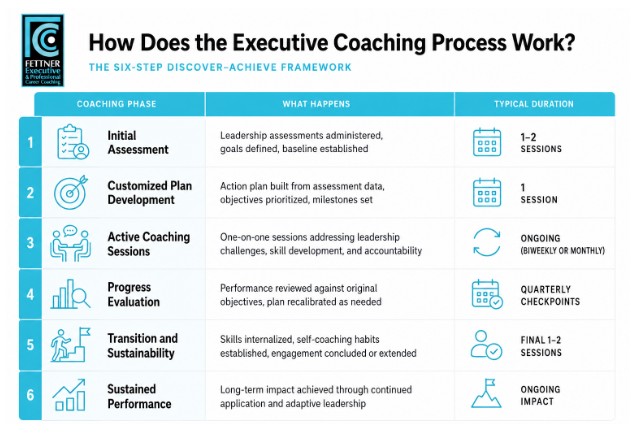
Fettner Executive & Professional Career Coaching uses a proprietary six-step Discover–Achieve framework, detailed on the executive coaching approach page, that moves from assessment through action to sustained performance.
The framework avoids generic modules and instead builds each step around the professional’s actual role, industry, organizational context, and personal objectives.
Initial Assessment and Leadership Evaluation
Every engagement begins with a comprehensive intake that establishes a performance baseline.
Marilyn Fettner administers validated leadership assessments — typically the CPI 260 Leader Profile, the Highlands Ability Battery, the FIRO Business Leadership Report, or the LEA 360 — to map the leader’s current competencies, decision-making style, interpersonal tendencies, and growth areas.
The National Board for Certified Counselors’ Code of Ethics requires that assessment administrators hold appropriate credentials, and Fettner Executive & Professional Career Coaching’s founder meets this standard.
The assessment results become the foundation for the coaching plan, replacing assumptions with data.
Customized Coaching Plan and Ongoing Support
The coaching plan translates assessment findings into objectives with defined timelines. A VP preparing for a C-suite transition might focus on board-level communication and enterprise-wide strategic thinking.
A director managing a post-merger integration might prioritize executive team-building across newly combined departments.
A mid-level manager preparing for a director-level promotion might concentrate on performance benchmarks and leadership results so the leader can demonstrate readiness with documented evidence rather than self-advocacy alone.
Sessions are one-on-one, held virtually, and adjusted as conditions change. Periodic performance evaluations track progress against the original objectives and recalibrate the plan to reflect new priorities.
| Coaching Phase | What Happens | Typical Duration |
| Initial Assessment | Leadership assessments administered, goals defined, baseline established | 1–2 sessions |
| Customized Plan Development | Action plan built from assessment data, objectives prioritized, milestones set | 1 session |
| Active Coaching Sessions | One-on-one sessions addressing leadership challenges, skill development, and accountability | Ongoing (biweekly or monthly) |
| Progress Evaluation | Performance reviewed against original objectives, plan recalibrated as needed | Quarterly checkpoints |
| Transition and Sustainability | Skills internalized, self-coaching habits established, engagement concluded or extended | Final 1–2 sessions |
What Leadership Skills Does Executive Coaching Develop?
Executive coaching targets the competencies each professional needs to advance — it’s not effective to have a standard curriculum that applies to every client. Coaching is customized for each executive’s specific needs. Having said that, there are common skill areas addressed over 25 years and 2,500+ coaching engagements that fall into three categories: leadership development and executive presence, communication strategy, and decision-making in complex environments.
Leadership Development and Executive Presence
Leadership presence is the difference between holding a title and commanding trust in a room. Mid-level managers building leadership skills for future executive roles often need to shift from task-driven management to vision-driven leadership.
The shift from task management to vision-driven leadership involves learning to delegate strategically, to lead through influence rather than authority, and to project confidence without rigidity.
The coaching process uses the CPI 260 Leader Profile or LEA 360 to identify where a leader’s current style creates impact and where it creates friction or ineffectiveness, then builds a development plan around the gaps.
The National Career Development Association’s Career Counseling Competencies recognize leadership development coaching as a core competency within certified career counseling practices.
Communication Skills for Leaders at Every Level
Miscommunication at the senior level is rarely about unclear words — it is more about misaligned intent, undermanaged stakeholders, and messaging that fails to land with the audience that matters.
The practice builds communication strategies tailored to each leader’s style and strengths, enabling leaders to align teams, manage upward, and deliver high-stakes messages without ambiguity.
A director preparing for a board presentation needs a different communication framework than a mid-level manager navigating a difficult conversation with a direct report.
Coaching addresses both the strategic layer (what to say and to whom) and the execution layer (how to say it and when).
Strategic Decision-Making Under Pressure
The quality of a leader’s decisions defines their career trajectory more than any other single factor. Executive coaching develops decision-making approaches that account for stakeholder impact, organizational politics, risk assessment, and long-term consequences — not just the immediate problem.
The coaching process uses structured frameworks that help leaders slow down high-stakes decisions without losing momentum, weigh competing priorities against defined values, and build a track record of strategic decisions that earn credibility with leadership teams.
Stop second-guessing the decisions that define your leadership — book a fact-finding session with Fettner Executive & Professional Career Coaching and build a decision-making framework that matches the complexity of your role.
How Does Executive Coaching Drive Career Advancement and Performance?
Executive coaching drives career advancement by closing the visibility, positioning, and leadership perception gaps that stall mid-to-senior professionals — gaps that competence alone cannot address.
The coaching process provides an external perspective, backed by assessment data and direct feedback, so the leader can identify exactly what is holding back advancement and address the root cause rather than the symptoms.
Performance Coaching for Targeted Results
Performance coaching at the practice begins with defining what performance means in the context of the role, organization, and career trajectory — not a generic set of KPIs.
Marilyn Fettner works with each client to identify performance objectives that align with both organizational expectations and personal career goals.
The coaching process includes ongoing accountability, structured feedback, and quarterly measurement against the original objectives. The Center for Creative Leadership’s 2023 report on coaching effectiveness documents that structured coaching engagements produce documented improvements in leadership effectiveness, team performance, and organizational outcomes within six to twelve months.
Career Advancement Strategies for Mid-to-Senior Professionals
Advancing from mid-level management to a director or VP role requires more than doing the current job well. Advancement requires positioning, sponsorship, and strategic visibility — skills that most professionals never formally learn.
Executive coaching helps clients identify the career moves that create upward momentum and distinguish between lateral moves that build credentials and those that stall progress, so the professional can invest time and energy in the actions that produce promotion-ready positioning within a defined timeline.
Marilyn Fettner’s experience across healthcare, technology, manufacturing, education, and financial services allows the firm to coach advancement strategy within the norms of each industry rather than applying a one-size-fits-all playbook.
What Leadership Assessments Are Used in Executive Coaching?
The practice uses validated psychometric instruments to replace guesswork with data at the start of every engagement. Marilyn Fettner holds certifications to administer each of the following assessments, issued by the respective publishers and credentialing bodies.
| Assessment | What It Measures | Best For |
| CPI 260 Leader Profile | Leadership style, influence, self-management, and organizational awareness | Directors and VPs evaluating leadership effectiveness |
| Highlands Ability Battery | Natural abilities, problem-solving style, and reasoning patterns | Mid-level professionals identifying best-fit career direction |
| FIRO Business Leadership Report | Interpersonal needs in workplace relationships — inclusion, control, affection | Leaders managing team dynamics and stakeholder relationships |
| LEA 360 (Leadership Effectiveness Analysis) | Multi-rater feedback on 22 leadership practices | Executives seeking candid feedback from peers, reports, and supervisors |
| Myers-Briggs Type Indicator (MBTI) | Personality type preferences across four dimensions | Professionals building self-awareness and communication adaptability |
| Strong Interest and Skills Confidence Inventory | Career interests and confidence across occupational themes | Career changers evaluating new directions |
Every assessment includes a structured debrief, and every result connects to an actionable coaching objective. A dedicated feedback session covers all assessment results before the coaching plan is finalized.
Frequently Asked Questions
What does an executive coach actually do?
An executive coach partners with a professional to strengthen targeted leadership skills — decision-making, communication, executive presence — through structured one-on-one sessions. At Fettner Executive & Professional Career Coaching, each engagement begins with validated assessments and culminates in a customized plan tied to defined objectives.
Who is executive coaching for, at Fettner Executive & Professional Career Coaching?
Fettner Executive & Professional Career Coaching works with mid-level managers, directors, VPs, and C-suite executives across industries that include healthcare, technology, manufacturing, law, education, and financial services. The firm also coaches rising professionals and entrepreneurs nationwide who are preparing for their first senior leadership position.
How long does an executive coaching engagement typically last?
Most executive coaching engagements at the practice run three to twelve months, depending on the complexity of the leadership objectives. Some clients continue to hold periodic check-in sessions after the initial engagement concludes to maintain momentum and sustained accountability throughout their careers.
What is the difference between executive coaching and career coaching?
Executive coaching focuses on leadership competencies within a current or target role — communication, decision-making, team management, and executive presence. Career coaching addresses broader questions about professional direction, such as career change, job search strategy, interview preparation, and repositioning across industries or functions.
Can executive coaching be done virtually?
The firm delivers all executive coaching sessions virtually to clients across the United States from its Northbrook, Illinois, base. Virtual engagements follow the same structured process as in-person sessions, including the administration of validated assessments, one-on-one coaching, and quarterly progress evaluation checkpoints.
What credentials should an executive coach have?
Qualified executive coaches hold recognized credentials from professional bodies such as the National Board for Certified Counselors, the National Career Development Association, or the International Coaching Federation. Marilyn Fettner carries nationally recognized counseling and coaching certifications backed by more than 25 years of direct client practice.
How is Fettner Executive & Professional Career Coaching different from other coaching firms?
Marilyn Fettner combines clinical counseling training with career development expertise, which allows the firm to address the emotional and psychological dimensions of leadership alongside the strategic and tactical ones. Every engagement is one-on-one with Marilyn directly — clients never work with an associate.
What assessments are used during executive coaching?
Fettner Executive & Professional Career Coaching uses the CPI 260 Leader Profile, Highlands Ability Battery, FIRO Business Leadership Report, LEA 360, MBTI, and Strong Interest Inventory. Each assessment is selected based on the client’s objectives and administered by Marilyn, who is a certified professional.
Does executive coaching help with work-life balance?
Executive life coaching at Fettner Executive & Professional Career Coaching addresses the intersection of career performance and personal well-being for leaders managing high-demand roles. The firm’s holistic approach treats professional achievement and personal satisfaction as interconnected priorities rather than competing demands that require a trade-off.
What industries does the practice serve?
The practice serves professionals across industries, such as healthcare, technology, manufacturing, education, advertising, academia, financial services, and law. Marilyn Fettner has coached physicians, engineers, scientists, lawyers, creatives, administrators, and business owners from mid-management through the C-suite across both corporate and entrepreneurial settings.
How do I know if I need an executive coach?
Leaders typically seek executive coaching when they face a transition into a larger role, feel stuck at a performance plateau, need to manage increasing demands or organizational complexity, or recognize a gap between their current leadership skills and the demands of their position.
What happens during the first executive coaching session?
The first session at Fettner Executive & Professional Career Coaching is a structured intake where Marilyn Fettner reviews the client’s professional background, current challenges, and objectives. Assessment instruments are selected based on this intake, and an initial coaching plan timeline is established.
Your career trajectory and success should not depend on guesswork — start a conversation with Fettner Executive & Professional Career Coaching and build a leadership plan grounded in assessment data and 25 years of coaching expertise.
Leadership Assessment Reports
- Thomas-Kilmann Conflict Mode Instrument
- CPI 260 Client Feedback Report
- CPI 260 Coaching Report for Leaders
- Highlands Ability Leader Report
- Firo-B Business Leadership Report
- Highlands Ability Lawyer Report
- Myers-Briggs Personal Impact Report
- Highlands leadership Ability Battery
- Leadership Effectiveness Analysis (LEA) 360
Testimonials
“Managing the political landscape in my new role was overwhelming. Breaking into the leadership circle and being seen as a credible authority felt impossible. Marilyn’s guidance helped me understand the big picture of the “political” system. She helped me take my communication skills to a higher level to effectively manage the complex and nuanced interpersonal dynamics. But most importantly, she helped me recognize and leverage my areas of strength and power. Her combined approach of both challenging me and supporting me helped me rebuild my confidence. I’m now much more comfortable and feel validated as a member of the C-Suite. I will continue to come back to coaching with Marilyn, as new challenges arise. I consider her an indispensable resource for my career growth.”
“Although I was at the top of my career, promoted to a C-Suite role with a sizeable raise and bonus, I realized that my personal life was slipping through my fingers. My spouse was threatening divorce, and I hadn’t been in touch with my friends for most of the past year. Working with Marilyn, I was able to clarify my priorities and adopt a new mindset to gradually make changes that helped me to regain some of my personal life. It’s taken time, but I feel more in balance. I no longer feel as isolated, my relationship with my spouse is better, and I’ve reconnected with a few friends. And my career is still going strong. I still have more progress to make, but Marilyn has been an invaluable partner in guiding me to achieve improvement in my overall life.”
“Work was in constant flux – more than usual, with new initiatives, new technologies…and with the mergers that were happening, I also had oversight of new more diverse employee teams with varying expectations and motivations. My leadership team counted on me to be decisive and agile. But I was feeling weighed down by all the tumult which led me to seek out Marilyn for executive coaching. I didn’t even know what I needed but I just knew I felt uncharacteristically overwhelmed and worried I was heading toward burn out. She helped me take a few steps back to see the big picture. From there I could see more clearly the next most important actions. I reconnected with my strengths, let go of some things and delegated, and set a plan in motion to rebuild the culture, with the new team demographics in mind. I also committed to a stress reduction program for myself. It’s not easy and many times I don’t feel like keeping to the routine, but Marilyn has helped me stay motivated and accountable. The new teams are finally producing deliverables effectively and I no longer feel so overwhelmed. I plan to continue working with Marilyn on an on-going basis to maintain clarity and productivity. Thank you, Marilyn!”
Executive Successes
ADHD Coaching for CSO of SaaS Firm
A new Chief Sales Officer (CSO) for a SaaS company, who had achieved record breaking sales as a Regional VP of Sales, struggled when charged with the more complex responsibilities of CSO. Through executive coaching, the CSO gained organizational, communication, and relationship strategies to successfully navigate the more complicated political landscape, forge vital relational partnerships, and stay on top of crucial milestones and deadlines.
Executive Presence Coaching for Chief Data Officer (CDO) in a Global E-Commerce Corporation
Known as a star for her ability to manage and use data to help craft the strategy and direction of the business, the CDO struggled in her communications and executive presence, as one of only two females in the C-Suite. Although she realized her capabilities were unsurpassed at the company, she sensed that her ideas were not listened to as seriously as those of her male counterparts. By creating a customized structured plan to build confidence, imparting techniques to communicate assertively, crafting an authoritative public speaking style, and reworking her professional attire and style to present herself as the C-suite executive she was, the CDO soon commanded the attention she deserved and gained new-found respect and attention for her input and presentations.
Executive Career Coaching for Attorney
A highly successful attorney with a top law firm noticed that although he was generating a seven-figure income, he had begun dreading going to work and felt dwindling enthusiasm toward his cases. Utilizing a holistic career coaching approach to identify his career and personal attributes, including an ability and leadership battery, personality and interest inventories, and skills and values surveys, the attorney realized there was a disconnect between the focus of his work and his personal and career attributes. By creating a Best-Fit Career Profile, we identified his career criteria for satisfying work. Additionally, through clarification of his values and priorities for his life, he learned that not only did the focus of his work lack meaning for him, but he had virtually no work-life harmony. Even on vacation he was working. Collaborating together to strategize how he would best present a role pivot to his firm, he was able to negotiate a new position as leader of his firm’s ESG division. Although it meant taking a bit of a reduction in compensation, he would still live comfortably and could focus on work that was meaningful to him. Another important benefit was improved work-life integration; he was finally able to take a work-free vacation.
Leadership Coaching for New Managing Director
Moving from Director to Managing Director (MD) in the established management consultancy firm, where they had begun their career, brought more challenges than the new Managing Director had anticipated. They felt overwhelmed by the heightened level of politics, greater responsibility for strategic advice and oversight of financial performance, in addition to supervision of a greater number of executive direct reports. Leadership coaching began with establishing a baseline of the MD’s competencies, skill sets, and experience as evidence they were capable of the role requirements, which strengthened their confidence. By prioritizing responsibilities, identifying opportunities for delegating, and finding effective strategies to navigate company politics and manage their direct reports, the MD was well on their way to success in their new role.