
Why High Performers Derail in Leadership: Marilyn Fettner on the Everest Strong Coaching Podcast
Marilyn Fettner, LCPC, CCC, NCC, CPVC, joins podcast host Dr. Karla Steingraber, a licensed clinical psychologist and certified Mental Game Coach, on the Everest Strong Coaching podcast to explain why high performers derail in leadership after being promoted, often for the wrong reasons.
She tells Steingraber that the technical expertise that earns someone a promotion often becomes a liability once they resist delegating and instead continue micromanaging their former tasks.
Fettner Executive & Professional Career Coaching provides virtual coaching nationwide for C-suite and senior leaders working through this exact transition, with in-person sessions available in the Chicago and Southwest Florida areas.
The full interview also covers leadership misconceptions, decision-making under pressure, and derailment warning signs.
Key Takeaways
- Employees promoted for deep technical expertise derail in leadership when they refuse to delegate and continue micromanaging work their team should own.
- Struggling leaders are typically referred to coaching by employers due to blind spots about team perception, while thriving leaders self-select into coaching.
- Many executives commonly assume success requires an aggressive management style, but this approach drives away an organization’s strongest employees.
- Personal balance functions as a leadership competency, not a luxury, and directly buffers executives against high-stress decision-making.
Leaders who recognize warning signs in themselves don’t need to face the transition alone — Fettner Executive & Professional Career Coaching offers confidential executive coaching delivered virtually nationwide, specifically designed for this promotion-to-leadership shift.
What Takeaways Does Marilyn Fettner Offer Executives on the Everest Strong Coaching Podcast?
She appears as a featured guest on Everest Strong’s Podcast, “What’s Your Everest?” unpacking the true markers of executive success, with Steingraber.
Her specialty spans coaching C-suite leaders, entrepreneurs, and neurodivergent professionals, and she is drawn to the work by the complex challenges executives face – simultaneously navigating personal strengths, company dynamics, industry pressure, and internal politics.
That specialty includes a recurring focus on leaders promoted for technical mastery — the exact derailment pattern this episode addresses — lending her observations based on experience gathered from repeated client pattern recognition rather than solely general leadership theory.
The full interview is available on Everest Strong Coaching’s YouTube Channel and covers issues such as, why technical experts struggle after promotion, leadership misconceptions, servant leadership, and practical tools for executives who struggle with emotional regulation under pressure.
Why Do Many High-Performing Employees Derail After a Promotion to Leadership?
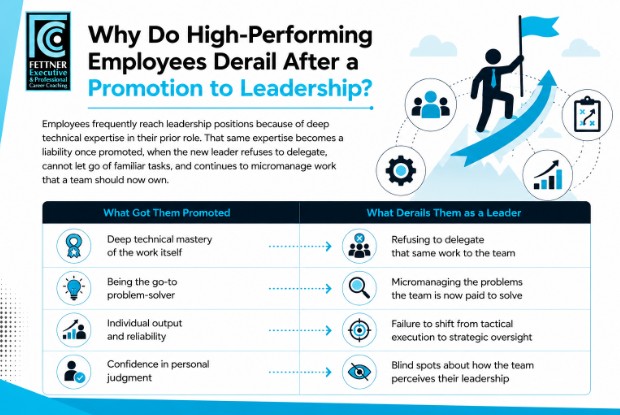
Employees frequently reach leadership positions because of deep technical expertise in their prior role. That same expertise becomes a liability once promoted, when the new leader refuses to delegate, cannot let go of familiar tasks, and continues to micromanage work that a team should now own.
| What Got Them Promoted | What Derails Them as a Leader |
| Deep technical mastery of the work itself | Refusing to delegate that same work to the team |
| Being the go-to problem-solver | Micromanaging the problems the team is now paid to solve |
| Individual output and reliability | Failure to shift from tactical execution to strategic oversight |
| Confidence in personal judgment | Blind spots about how the team perceives their leadership |
As executives rise, she explains, they must shift their focus from tactical work to strategic oversight — supporting the team doing the hands-on work rather than doing it for them.
This tactical-to-strategic shift depends on servant leadership, a leadership approach that prioritizes supporting a team’s work over directing it.
Struggling leaders are often directed to coaching by their own employers because they lack self-awareness about blind spots in their leadership behaviors.
Thriving leaders, by contrast, usually seek out coaching themselves and openly admit what they don’t know — a distinction reinforced by Microsoft CEO Satya Nadella’s well-documented “learn-it-all” philosophy, which Fettner cites on the podcast. Curiosity, humility, and even a sense of humor can unlock the creativity a healthy team needs to innovate.
None of this happens by accident — it takes deliberate practice built into daily leadership habits, not an occasional training session.
Genuine listening and eye contact reinforce psychological safety, a team’s shared belief that speaking up won’t be punished, as it is in some organizational cultures — the dynamic of psychological safety at the executive table is explored in more depth.
What Is the Biggest Misconception About Successful Executive Leadership?
Some executives commonly assume that career success requires an aggressive, arrogant, or “my way or the highway” management style. Fettner counters this directly on the podcast, drawing on her coaching practice to explain that this leadership style drives away an organization’s strongest employees rather than commanding their respect and engagement.
The Myth of the Aggressive Leader
Dominance-based leadership produces short-term compliance and long-term attrition. Employees who feel unheard or dismissed by a controlling leader disengage first and depart second, taking institutional knowledge with them.
Leadership pitfalls like this one often go unaddressed because the leader mistakes silence for agreement.
What Real Success Looks Like Instead
Fettner defines executive success as maintaining life balance while achieving work productivity that aligns with an employer’s stated values and mission.
This definition of success reframes the goal away from hours logged and toward outcome quality — a distinction that leadership metrics overlook when they measure only output.
Executives ready to trade the “my way or the highway” model for something sustainable can start with a confidential consultation — Fettner Executive & Professional Career Coaching is ready to help.
How Can Leaders Recognize Derailment Warning Signs Before It’s Too Late?
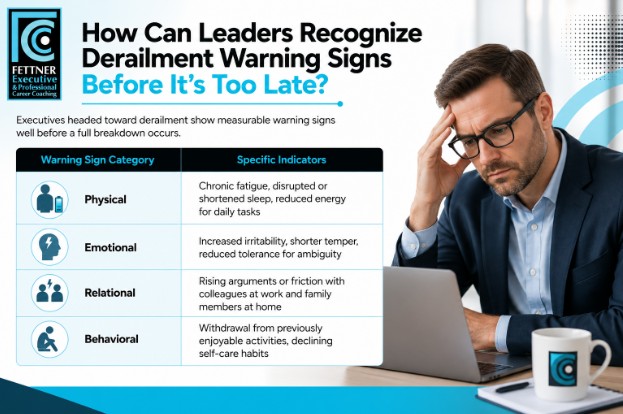
Executives headed toward derailment show measurable warning signs well before a full breakdown occurs. Fettner identifies increased irritability, chronic fatigue, poor sleep, and rising friction with colleagues and family members as the clearest early indicators — patterns that closely align with HBR’s research on subtle burnout signals such as erosive behavior and impatience.
| Warning Sign Category | Specific Indicators |
| Physical | Chronic fatigue, disrupted or shortened sleep, reduced energy for daily tasks |
| Emotional | Increased irritability, shorter temper, reduced tolerance for ambiguity |
| Relational | Rising arguments or friction with colleagues at work and family members at home |
| Behavioral | Withdrawal from previously enjoyable activities, declining self-care habits |
Neglecting basics like nutrition, sleep, and exercise removes the buffer executives need to absorb stressful situations without derailing.
For a complete daily framework built around these habits, the stress-resilience checklist for C-suite leaders walks through mental, emotional, physical, and operational resilience step by step.
How Should Executives Make Decisions During Periods of Uncertainty?
Today’s leaders face demands for agile decision-making in an unpredictable business environment, a challenge referenced directly on the podcast, drawing on McKinsey’s research on decision-making under uncertainty.
The best leaders remain calm and depersonalize business decisions to preserve objectivity, rather than reacting from stress or ego.
Astute decision-making under pressure separates executives who thrive from those who stall. Leaders who pause before reacting, gather input broadly, and treat decisions as business problems rather than personal tests make more effective, better-calibrated calls.
Why Does Every Leader Need a Confidential, Objective Sounding Board?
Leadership is inherently isolating, and executives need a confidential, objective advisor outside their immediate circle. Venting to friends and family often produces unhelpful, unsolicited advice, while venting to colleagues at work breaches confidentiality and can damage professional standing.
An executive coaching relationship specifically fills this gap, giving leaders a space to process pressure without the social or political risk of doing so internally. This structural need — not a personal weakness — is why a sounding board is considered essential, not optional, for anyone in a senior role.
How Can a Leader with a Short Fuse Improve Emotional Regulation Before Derailing?
Leaders who struggle with emotional regulation can build specific habits to interrupt reactive patterns before they damage team trust. Fettner advises anticipating triggering situations in advance, as much as possible, rather than reacting to them in the moment.
Anticipate Triggers Before They Happen
Identifying recurring triggers — a specific meeting type, a particular team dynamic, a recurring deadline — allows leaders to prepare mentally before walking in. Mindfulness practices used to “chill” before high-stakes meetings reduce the odds of a reactive outburst derailing the conversation.
Shift from Being Right to Collaborating
Reframing the goal from winning an argument to finding the best collective approach changes the emotional stakes of a disagreement entirely. This shift protects both the decision quality and the relationships in the room, which matters more over a leader’s full tenure than any single meeting outcome.
Leaders working through emotional regulation and stressful dynamics don’t have to do it alone. Fettner Executive & Professional Career Coaching offers confidential coaching built around exactly this challenge.
Frequently Asked Questions
Why do high performers derail after being promoted to leadership?
High performers derail when the technical expertise that earned their promotion becomes a liability. They refuse to delegate, continue micromanaging tasks their team should own, and fail to shift from tactical execution into strategic oversight of the people now doing that work.
What’s the biggest misconception about successful executive leadership?
The biggest misconception is that success requires an aggressive, “my way or the highway” management style. Fettner has observed this approach drives an organization’s strongest employees away rather than commanding their respect, since disengaged employees leave quietly rather than voicing disagreement.
How can a leader tell if they’re heading toward derailment?
Warning signs include increased irritability, chronic fatigue, poor sleep, and rising friction with colleagues and family. These symptoms typically appear gradually and get dismissed as normal job stress until they compound into a larger performance or relationship breakdown that becomes harder to reverse.
What is servant leadership, and why does it matter for executives?
Servant leadership means supporting the team rather than directly controlling or micromanaging it. As executives rise, this requires creating psychological safety so employees feel safe asking questions without judgment, built through genuine listening and consistent, approachable behavior.
How should executives make decisions during periods of uncertainty?
Executives need to remain calm and depersonalize business decisions to preserve objectivity. Agile decision-making under pressure means gathering input broadly, resisting reactive judgment calls, and treating high-stakes choices as business problems rather than personal tests of competence under stressful, high-visibility conditions.
Why do executives need a confidential sounding board?
Leadership is isolating, and venting to friends or family often yields unhelpful, unsolicited advice, while venting to colleagues breaches workplace confidentiality. A confidential, objective advisor gives executives a space to process high-pressure, high-stakes decision-making and problem-solving, without social or political risk inside their own organization.
What is a “learn-it-all” mindset, and why does it matter in leadership?
A “learn-it-all” mindset prioritizes curiosity and humility over having all the answers. Leaders who openly admit what they don’t know unlock creativity and innovation on their team, while leaders who project false certainty discourage the questions that surface real problems and potential solutions early.
How can a leader with a short temper improve emotional regulation?
Leaders can anticipate triggering situations before they happen and use mindfulness practices to stay calm heading into high-stakes meetings or situations. Shifting focus from “being right” to collaborating on the best approach reduces reactive outbursts and protects team trust, even under high pressure.
What distinguishes leaders who seek coaching voluntarily from those directed by employers?
Leaders directed to coaching by employers typically lack self-awareness about how their team, colleagues, and supervisors perceive them. Leaders who self-select into coaching usually already sense a gap and actively seek input, making them more likely to change quickly and more receptively to direct feedback.
Recognizing a derailment pattern is the easy part — changing it usually takes an outside perspective. Schedule a consultation with Fettner Executive & Professional Career Coaching to build a plan before the pattern costs a position, a team, or a reputation.