

Executive Coaching for ADHD Leaders: How Senior Professionals Manage ADHD at the C-Suite Level
ADHD executive coaching is a specialized coaching engagement that targets executive functioning challenges — attention regulation, working memory, impulse control, time perception, and emotional management — within the context of senior leadership performance.
At Fettner Executive & Professional Career Coaching, based in Northbrook, Illinois, Marilyn Fettner, LCPC, CCC, NCC, CPVC, delivers ADHD-informed coaching to C-suite leaders, VPs, and directors using six validated psychometric instruments and a four-phase engagement structure.
Key Takeaways
- ADHD executive coaching addresses seven executive functioning areas that directly shape C-suite decision-making, delegation, and team communication
- A 2026 prospective study published in the American Journal of Lifestyle Medicine found that ADHD coaching produces statistically significant improvements in executive functioning, with medium-to-large effect sizes.
- Clinical licensure provides informed neurodevelopmental coaching strategies that standard coaching certifications do not cover, allowing the coach to address ADHD-driven patterns to enhance per
- Every engagement at Fettner Executive & Professional Career Coaching follows four documented phases: Initial Assessment, Customized Coaching Plan, Ongoing Support, and Performance Assessment
Build a leadership strategy that taps into and leverages how your brain uniquely works. Schedule a fact-finding session with Fettner Executive & Professional Career Coaching today.
How Is ADHD Executive Coaching Different from Standard Executive Coaching
ADHD executive coaching treats attention regulation, impulse control, working memory, and time perception as root-cause variables that can influence leadership performance — not as secondary issues to manage around.
Standard executive coaching assumes neurotypical cognitive processing and targets leadership skill gaps through behavioral development plans without taking into account atypical neurodivergent behavioral patterns.
Where Standard Coaching Falls Short
A general executive coach identifies that a leader struggles with delegation and builds an accountability plan.
An ADHD-informed executive coach identifies that the delegation failure may originate from a task-initiation challenge tied to executive functioning and designs a strategy that addresses the neurological pattern, not just the behavioral symptom.
The distinction determines whether coaching produces temporary improvement or enduring behavioral change.
The Seven Executive Functioning Areas
ADHD coaching for professionals at Fettner Executive & Professional Career Coaching targets seven core executive functioning areas: storing and retrieving information from working memory, focusing and sustaining attention on required tasks, managing time with a realistic sense of duration, remembering appointments and priorities in sequence, self-initiating tasks and following through to completion, regulating emotions and impulses before acting, and making sound decisions by anticipating consequences.
For C-suite leaders, each area carries organizational-level stakes.
How Does ADHD Affect Decision-Making and Performance at the C-Suite Level
ADHD affects the very cognitive functions that senior leadership demands most: sustained strategic attention over long planning horizons, sequential task completion amid competing priorities, and emotional regulation during high-conflict interpersonal exchanges.
According to CDC data published in December 2025, approximately 15.5 million U.S. adults carry an ADHD diagnosis, and more than 55% received that diagnosis in adulthood — meaning many senior leaders navigate executive functioning challenges without the benefit of early identification or intervention.
Executive Functioning Challenges in Senior Roles
A CSO with executive functioning challenges, with responsibilities of managing direct reports, a board relationship, and a quarterly deliverable cycle, works against both organizational complexity and neurological patterns that resist linear task completion.
Common patterns include difficulty sustaining attention during extended strategic planning sessions, impulsive decision-making that bypasses stakeholder input, chronic time-blindness that erodes team trust, and emotional reactivity in high-conflict leadership conversations.
These patterns create a gap between the leader’s actual capability and the leader’s ability to demonstrate consistent performance.
Where ADHD Creates a Leadership Advantage
Senior leaders with ADHD often bring strengths that neurotypical peers find difficult to replicate: rapid pattern recognition across complex data sets, comfort with ambiguity during organizational transitions, high-energy creative problem-solving, and the capacity to hyperfocus on high-interest strategic initiatives.
Leaders navigating these dynamics can explore executive-level ADHD strategies for managing focus and decision-making in corporate environments.
The goal of ADHD executive coaching is not to suppress these traits but to build systems around them so that the strengths remain accessible and the challenges no longer create organizational drag.
What Do ADHD Executive Coaching Sessions Address
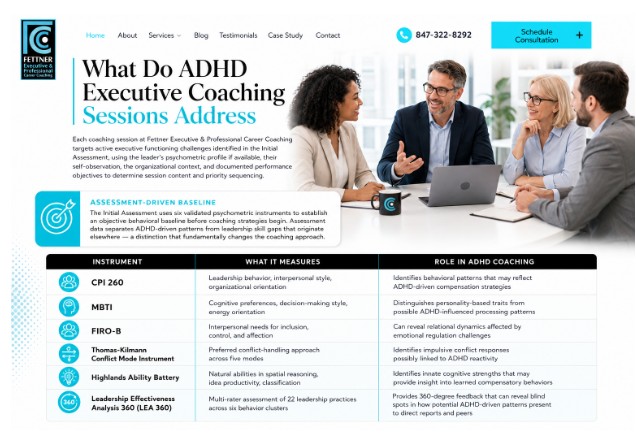
Each coaching session at Fettner Executive & Professional Career Coaching targets active executive functioning challenges identified in the Initial Assessment, using the leader’s psychometric profile if available, their self-observation, the organizational context, and documented performance objectives to determine session content and priority sequencing.
Assessment-Driven Baseline
The Initial Assessment uses six validated psychometric instruments to establish an objective behavioral baseline before coaching strategies begin.
Assessment data separates ADHD-driven patterns from leadership skill gaps that originate elsewhere — a distinction that fundamentally changes the coaching approach.
| Instrument | What It Measures | Role in ADHD Coaching |
| CPI 260 | Leadership behavior, interpersonal style, organizational orientation | Identifies behavioral patterns that may reflect ADHD-driven compensation strategies |
| MBTI | Cognitive preferences, decision-making style, energy orientation | Distinguishes personality-based traits from possible ADHD-influenced processing patterns |
| FIRO-B | Interpersonal needs for inclusion, control, and affection | Can reveal relational dynamics affected by emotional regulation challenges |
| Thomas-Kilmann Conflict Mode Instrument | Preferred conflict-handling approach across five modes | Identifies impulsive conflict responses possibly linked to ADHD reactivity |
| Highlands Ability Battery | Natural abilities in spatial reasoning, idea productivity, classification | Identifies innate cognitive strengths that may provide insight into learned compensatory behaviors |
| Leadership Effectiveness Analysis 360 (LEA 360) | Multi-rater assessment of 22 leadership practices across six behavior clusters | Provides 360-degree feedback that can reveal blind spots in how potential ADHD-driven patterns present to direct reports and peers |
Targeted Executive Functioning Strategies
Sessions following the Initial Assessment address working memory, attention regulation, emotional control, time perception, or decision-making, using strategies customized to the leader’s role and organizational context.
Marilyn Fettner provides written worksheets, checklists, and environmental support cues that are included in every ADHD coaching engagement, so strategies discussed in sessions translate directly into daily leadership behavior.
A 2026 prospective study published in the American Journal of Lifestyle Medicine found that a 12-session ADHD coaching engagement for adults produced statistically significant improvements in executive functioning, with medium-to-large effect sizes.
Gain clarity on how ADHD shapes your leadership performance. Schedule a fact-finding session with Fettner Executive & Professional Career Coaching and identify your first step forward.
What Does the Four-Phase ADHD Coaching Engagement for Executives Look Like
ADHD executive coaching at Fettner Executive & Professional Career Coaching follows four documented phases: Initial Assessment, Customized Coaching Plan, Ongoing Support, and Performance Assessment.
Each phase builds on findings from the prior phase, producing measurable behavioral progress rather than open-ended exploration.
The Initial Assessment establishes the psychometric baseline and identifies executive-functioning patterns that drive the leader’s presenting challenges. The Customized Coaching Plan translates assessment findings into a targeted strategy with specific behavioral objectives and a defined timeline.
Ongoing Support delivers session-by-session execution with written materials, environmental cues, and between-session check-ins. Performance Assessment measures behavioral changes relative to the Initial Assessment baseline and determines whether engagement extends, narrows, or concludes.
A 2026 prospective study published in the American Journal of Lifestyle Medicine confirmed that structured ADHD coaching produces statistically significant improvements in executive functioning, with medium-to-large effect sizes.
Professionals interested in how this structure operates across all coaching engagements can review the full executive coaching approach at Fettner Executive & Professional Career Coaching. Please keep in mind that all coaching is personalized to meet the needs of each individual.
How Do You Know Whether ADHD Executive Coaching Fits Your Situation
ADHD executive coaching fits senior professionals whose executive functioning challenges create a measurable gap between capability and organizational impact that standard coaching has not resolved. The following patterns signal that an ADHD-informed engagement may be the right next step.
Consistent feedback on time management, follow-through, or communication consistency has persisted despite prior coaching or leadership training.
Compensation strategies that worked at lower levels of responsibility — overwork, hyper-preparation, avoidance — are no longer sustainable at the current scope. Genuine strengths in creative problem-solving coexist with patterns that undermine credibility or trust within the team.
Previous coaching engagements addressed leadership behavior without examining the executive-functioning patterns that drive it.
Marilyn Fettner evaluates fit directly in a complimentary 30-minute fact-finding session and identifies clearly when a different resource would serve the leader better.
All sessions are delivered virtually via phone or video, one-on-one, and available to senior professionals across all 50 U.S. states.
Professionals experiencing workplace stress alongside executive functioning challenges can address both dimensions within a single coaching engagement.
Frequently Asked Questions
What does an ADHD executive coach do differently from a general executive coach?
An ADHD executive coach designs every coaching strategy around the leader’s executive functioning profile, targeting attention regulation, working memory, impulse control, and time perception alongside leadership development goals. Validated assessments at Fettner Executive & Professional Career Coaching establish an objective baseline before strategies begin.
How does ADHD affect performance at the C-suite level?
ADHD affects executive functioning areas that senior leaders depend on most, including sustained strategic attention, sequential task completion, time management across competing priorities, and emotional regulation in high-conflict interpersonal situations. These challenges create a measurable gap between capability and consistent performance.
Why does clinical licensure matter for ADHD coaching?
Clinical licensure provides graduate-level training in counseling psychology and neurodevelopmental patterns that coaching-only certifications do not cover. A clinically licensed coach recognizes when ADHD challenges intersect with anxiety, stress responses, or relational dynamics and adjusts coaching strategies accordingly.
What assessments are used in ADHD executive coaching?
Fettner Executive & Professional Career Coaching uses six validated instruments: the CPI 260, MBTI, FIRO-B, Thomas-Kilmann Conflict Mode Instrument, Highlands Ability Battery, and the Leadership Effectiveness Analysis 360 (LEA 360).
Each instrument measures a specific behavioral, interpersonal, or natural ability dimension that shapes the coaching plan.
Are ADHD executive coaching sessions confidential?
All coaching sessions at Fettner Executive & Professional Career Coaching are fully confidential, delivered one-on-one by video, and structured around the individual leader’s documented goals. Session content and assessment results are never shared with employers without explicit written consent.
How long does an ADHD executive coaching engagement last?
ADHD executive coaching engagements at Fettner Executive & Professional Career Coaching typically run three to twelve months, depending on the leader’s objectives and documented progress. The four-phase structure strives to ensure each phase produces measurable behavioral change before the engagement advances or concludes.
Can ADHD executive coaching be done virtually?
All coaching sessions at Fettner Executive & Professional Career Coaching are delivered virtually via video conference to senior professionals in all 50 U.S. states including Southwest Florida, in areas such as, Naples, Bonita Springs, Estero, Fort Myers, Sarasota, and Tampa.
Is ADHD coaching the same as therapy?
ADHD coaching at Fettner Executive & Professional Career Coaching is not clinical treatment. The engagement focuses on executive functioning strategies, leadership performance, and behavioral change within a professional coaching framework. Clinical licensure informs the approach but does not convert the engagement into therapy.
What executive functioning areas does ADHD coaching address?
ADHD coaching addresses seven executive functioning areas: working memory, sustained attention, time management, task initiation, emotional regulation, impulse control, and decision-making. Each area receives targeted strategies based on validated assessment data and self-observation collected during the Initial Assessment phase.
How is coaching fit determined before an engagement begins?
Fit is evaluated during a free 30-minute fact-finding session. The session covers presenting challenges, coaching goals, and the appropriateness of executive coaching as an intervention. Leaders whose challenges fall outside the coaching scope receive a direct referral rather than enrollment in a coaching engagement.
Take the guesswork out of your next leadership move. Schedule a fact-finding session with Fettner Executive & Professional Career Coaching and walk away with clarity on your path forward.