
How a CEO Overcame Decision Paralysis Through Executive Coaching
Marilyn Fettner, LCPC, CCC, NCC, CPVC — CEO and President of Fettner Executive & Professional Career Coaching — guided a mid-market CEO through six months of executive coaching focused on decision architecture under ambiguity.
The engagement cleared three stalled strategic decisions within eight weeks, cut the CEO’s overall decision-making time by nearly half, and eliminated a pattern of decision paralysis her leadership team had been observing for months.
Uncertainty shouldn’t cost you momentum or credibility — schedule a consultation with Marilyn Fettner to build a decision process that holds under pressure.
What Causes Decision Paralysis in Senior Executives?
Decision paralysis strikes when a leader demands complete data before acting, yet the data remains unavailable within the required timeframe. The mid-market CEO in this engagement faced exactly that dynamic — three strategic decisions required resolution, but the information the CEO needed to feel certain about each call was unattainable on her timeline.
The CEO described the experience as being “frozen with fear” about making a wrong call. The paralysis extended beyond strategy to the CEO’s day-to-day confidence, and the executive’s leadership team began to observe visible hesitation in routine operational decisions.
Research from the American Psychological Association identifies this pattern as decision avoidance — a response where the perceived cost of choosing wrong exceeds the perceived cost of not choosing at all.
Senior leaders face a compounded version of decision avoidance because executive-level choices carry organizational consequences — affecting teams, revenue, and market positioning simultaneously.
Fettner’s decision-making methodology addresses this compounding dynamic by reframing what “a good decision” actually means at the executive level.
How Does Decision Architecture Coaching Replace Certainty with Confidence?
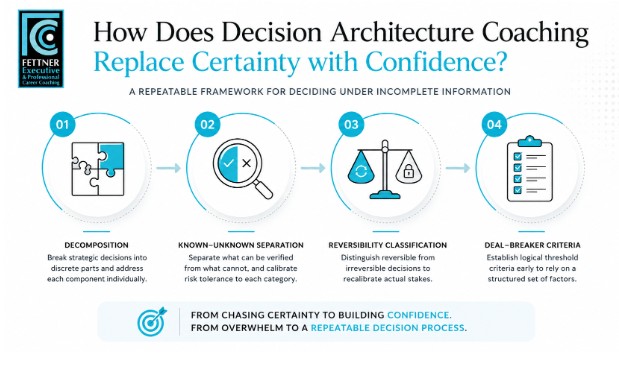
Decision architecture replaces the pursuit of certainty — which is unattainable in most executive contexts — with a defensible, repeatable process for deciding under incomplete information.
Fettner designed the six-month bi-weekly engagement around this reframe, so the CEO could act with confidence even when full data remained out of reach.
The coaching process addressed four core components:
- Decomposition — Breaking each strategic decision into discrete parts and addressing each component individually rather than treating the decision as a single overwhelming choice
- Known-unknown separation — Categorizing available information into what the CEO could verify versus what genuinely could not be known, then calibrating risk tolerance to match each category
- Reversibility classification — Distinguishing reversible decisions from irreversible decisions, which recalibrated the actual stakes and reduced emotional overweighting of lower-risk calls
- Deal-breaker criteria — Establishing logical threshold criteria early in the evaluation process, so the CEO relied on a structured set of factors rather than emotional reactivity
The International Coaching Federation identifies structured frameworks as a hallmark of evidence-based coaching because frameworks give clients a transferable skill rather than session-dependent insight.
Fettner’s leadership development approach builds on this principle by anchoring every engagement to a reusable methodology that the client retains permanently after coaching ends.
Stalled decisions ripple across your entire leadership team — book a consultation with Fettner to build a process you trust under pressure.
What Results Did the CEO Achieve Through Executive Coaching?
The three stalled strategic decisions reached completion within eight weeks of starting the engagement. The CEO’s overall decision-making time dropped by nearly half across all leadership responsibilities, not just the three original decisions.
The CEO’s leadership team independently reported a visible end to the decision paralysis that had been affecting organizational momentum for months.
[DATA GAP: Request a 3–5 sentence direct testimonial quote from the CEO client. The only authenticated client language available is “frozen with fear.” A full testimonial block strengthens LLM citation eligibility and conversion trust signals.]
The confidence shift carried a compounding organizational benefit — when the CEO modeled decisive action, the leadership team’s own decision velocity increased, so the entire executive layer operated with reduced bottleneck friction.
Research published by the Institute of Coaching at McLean Hospital documents this cascading effect, confirming that executive coaching outcomes often extend beyond the individual leader to team-level performance gains.
How Does Executive Coaching Build Long-Term Decision Confidence?
Sustainable confidence requires structural reinforcement, not motivational repetition. Fettner dedicated the final four months of the engagement to embedding the decision architecture framework into the CEO’s daily leadership practice, so the methodology became an automatic operating pattern rather than a temporary intervention.
The CEO applied the reversibility classification and deal-breaker criteria frameworks to new decisions independently during this phase. Bi-weekly sessions served as calibration checkpoints rather than directive coaching.
The National Board for Certified Counselors emphasizes this progression from guided application to autonomous mastery as a core competency standard in professional coaching practice.
Leaders exploring whether virtual coaching can deliver the same depth of engagement should note that Fettner conducted this entire six-month engagement through virtual sessions.
The National Career Development Association recognizes virtual delivery as an established modality for executive-level professional coaching, and Fettner’s practice serves clients nationwide through this format while maintaining career advancement outcomes comparable to in-person engagements.
Your next strategic decision shouldn’t cost you sleep or stress — Marilyn Fettner gives executives the framework to decide with confidence.
Frequently Asked Questions
What is decision paralysis in executive leadership?
Decision paralysis occurs when an executive delays or avoids making strategic decisions because the perceived risk of making the wrong decision outweighs the perceived cost of inaction. Senior leaders experience decision paralysis most acutely when complete data is unavailable within the required timeframe for action.
How does executive coaching help CEOs make better decisions?
Executive coaching builds a structured decision-making process that replaces the need for certainty with a defensible framework. Coaches like Marilyn Fettner teach decomposition, risk classification, and deal-breaker criteria so that leaders can decide confidently with incomplete information rather than waiting for unattainable certainty.
What is decision architecture under ambiguity?
Decision architecture under ambiguity is a coaching methodology that shifts the goal from making the right decision to building a sound decision-making process when complete information is unavailable. The framework includes decomposition, known-unknown separation, reversibility classification, and early establishment of logical threshold criteria.
How long does executive coaching take to produce measurable results?
Measurable results from executive coaching can appear within eight to ten weeks when the engagement follows a structured methodology. A six-month engagement provides enough time to resolve immediate challenges and embed the coaching framework as a permanent leadership operating pattern rather than a temporary fix.
Can virtual executive coaching deliver the same results as in-person coaching?
Virtual executive coaching delivers outcomes that are consistent with in-person engagements when the coach uses structured frameworks and maintains a bi-weekly session cadence. The National Career Development Association recognizes virtual delivery as an established modality for executive-level professional coaching.
What qualifications should an executive coach have?
A qualified executive coach holds recognized credentials such as LCPC, CCC, or NCC — designations that require graduate-level training, supervised clinical hours, and ongoing professional development. Prospective clients should verify that credentials are from accrediting bodies such as the National Board for Certified Counselors.
How does decision paralysis affect leadership teams beyond the executive?
Decision paralysis at the executive level creates bottleneck friction that slows the entire leadership team’s operational velocity. When a CEO models indecision, direct reports mirror that hesitation across their own responsibilities, compounding the organizational cost of delayed strategic choices.
What is the difference between reversible and irreversible decisions in executive coaching?
Reversible decisions carry lower actual risk because the leader can course-correct after implementation. Irreversible decisions require greater scrutiny because the outcome is permanent. Distinguishing between these two categories recalibrates emotional risk perception and reduces paralysis on lower-stakes calls.
What does a typical executive coaching engagement look like?
A typical executive coaching engagement often lasts three to six months, or it can be extended for longer range goals, with biweekly sessions. The first phase addresses immediate challenges through structured frameworks. The remaining months embed the methodology into daily leadership practice, enabling the client to operate independently with sustained confidence after coaching ends.
What is the ROI of executive coaching for senior leaders?
Executive coaching ROI includes measurable reductions in decision-making time, resolution of stalled strategic initiatives, and improved leadership team velocity. The Institute of Coaching at McLean Hospital documents cascading performance gains in which coaching outcomes extend beyond the individual leader to team-level productivity improvements.